
What’s the beef? Farmers refuse to “cow-tow” to President Trump’s import plan
What’s the beef? Farmers refuse to “cow-tow” to President Trump’s import plan
The administration’s new import plans have led farmers at the New York State Fair to develop their own strategy to save American beef.
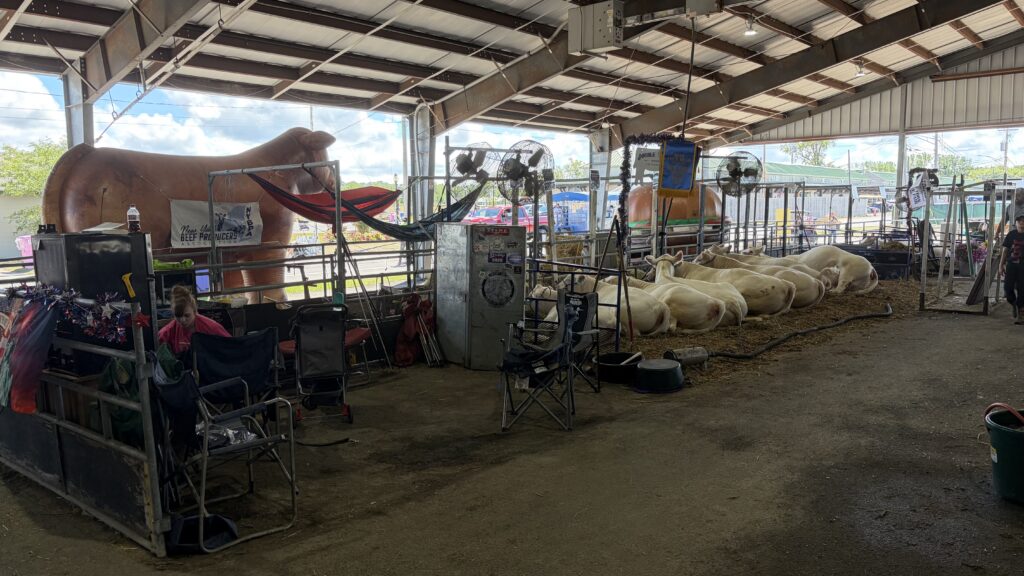
This past month, President Trump unveiled his plan to allow up to 300,000 metric tons of imported lean ground beef into the American market. The plan was designed to reduce prices for consumers at a time of record-low cattle herd sizes, but it has led some farmers at the New York State Fair to reconsider their own business strategies amidst concerns about losing business.
“Buy local,” Dylan Walley, a young upstate New York cattle producer, said in response to the plan, “try to look for the locally sourced meat and buy that.
The lowest cattle inventory for 75 years has pushed the price of a pound of beef up to a record high of $6.89, a 57% increase in the last five years, according to the U.S. Bureau of Labor Statistics.
Walley fears that flooding the market will cause beef prices to plummet and threaten the survival of the average American beef producer. The need to diversify to earn extra income has become increasingly important.
“My gut reaction is it’s going to tank our market, we’re going to watch our prices for our cows drop,” Walley said.
This year at the fair, Walley is working as a fitter, preparing cows for show for four different farms. At Walley’s farm, Gold-N-Ayr dairy farm in Walton, N.Y., he’s taking steps to increase the value of his herd to offset the anticipated losses.
“We only need half of our herd to be bred dairy for our milking replacements. So, the other half we breed to beef cows,” Walley said. “A beef-dairy cross, they’ll come out black. When they hit the ground, we can sell them right away.”
With fast growth speeds, black calves cost less to steer. The high quality beef can command an instant premium, often selling for up to $2000 at auction, which is $500 more than if kept as a purebred dairy bull.
The import surge is likely to affect mainly lower quality ground beef blends, rather than the high-choice cattle, meaning selling a black calf will remain a viable quick-buck and quick-turnaround for dairy farmers. Walley says beef farmers should tap into this lucrative cross-breeding market.
However, following Walley’s cross-breeding plan and crossing fingers for the more lucrative black bull to be calved is not a secure long-term strategy for some beef farmers.
Neither is the option to switch to dairy. It requires a massive investment to overhaul the entire farm infrastructure. Raising and feeding dairy cows is significantly more expensive than beef cows, and milk prices fluctuate wildly, replacing one uncertainty with another.
New York cattle farmer, Tim Pallokat said he fears that the impact of the imports will be immediate.
“To add beef into an already struggling market to lower the price for the consumer at the store is going to hurt every farm in New York and across the country,” he said.
But Pallokat’s not interested in a quick fix. He’s found a long-term solution elsewhere.
“The producer needs to share with the consumer 100% where that beef comes from, and then Americans could decide what product they want to buy when they go to the store,” he said.
He’s calling on the government to implement stricter testing and country of origin labelling on all meat products to entice Americans to stick with local beef.
Pallokat believes if given the choice, Americans will choose USDA certified American beef that they know has passed rigorous inspection over imported beef they are not sure has been held to the same standard. But they need to be given the choice.
Patrick Reeves, manager of Country Corner, home to the Heart Attack Burger, agreed.
“I would be personally willing to boycott it, if that was something available to me,” he said, “that relies on distributors like Sysco, giving us an option to solely pick meat that comes from the United States,” he said.
For vendors reliant on wholesalers, the choice to abstain from buying imported beef is not as easy as a local independent farmer who controls every stage of the operation from field to fork.
Butcher Larry Althizer transports, slaughters and sells all of his own beef directly to customers through his shop at the AK Sunset Ranch in Mount Vision, N.Y. He said it’s a great way to keep costs down and educate the public about where their beef comes from. He plans to continue selling privately to ensure only American beef reaches Americans.
Walley says consumers should buy their beef from one-man-band farmers like Althizer as it helps to keep the U.S. dollar in American hands.
“If you can find a farmer that does packaging himself and sells it individually, buy it that way,” Walley said.
President Trump’s stated aim of lowering consumer prices by increasing imports doesn’t necessarily have to be bad news for American farmers, according to small cattle producer, Amy Pyra.
“As a producer, I’m not overly worried about it for us, we have a small farm stand and people like buying local beef, so we’re able to process that way,” she said.
She said establishing a personal relationship with the buyer will be key to making sure her customers continue to buy from her instead of the cheaper supermarkets. She said the rising input costs of fuel and fertilizer linked to the war in Iran make cutting down on outsourcing vital to staying afloat.
“If you can process your own or have a local processor that can process it and be able to sell it, that’s a great way to sell your beef for a decent price,” Pyra said.
In a week when another feud was ignited with Canada over President Trump’s signing of an executive order to rename Lake Ontario to Lake America, Pallokat offered another way to ensure that American beef dinners remain homegrown in North America.
“My thought would be that Canada and the U.S. could work together and have one product,” he said.
In these first few days following the imports, Pallokat said he wants to see how the market settles before figuring out how to move ahead with this partnership plan.
But not everyone sees the need to save the American beef industry.
“Frankly, if I want to buy a steak dinner for $20 versus 40, I’d probably head for the $20 steak,” Dean Hilts, an elderly amateur tractor enthusiast, said. “As long as the beef isn’t mass-produced, I wouldn’t have a problem supporting meat coming from a different country.”
Small beef producer, Louise Ando is also relaxed about it all but for a different reason.
“I’m a Trump person, so whatever he says, I’m good with,” she said.
She doesn’t feel the need to make any contingency plans in response to the president’s import plan, offering some advice to her fellow Americans:
“Eat a hot dog. Eat more chicken,” Ando said.
