
Syracuse University faculty panel warns academic freedom is under pressure
Syracuse University faculty panel warns academic freedom is under pressure
During Banned Books Week, three SU faculty members explored the threats facing academic freedom, from banned books to censored syllabi.
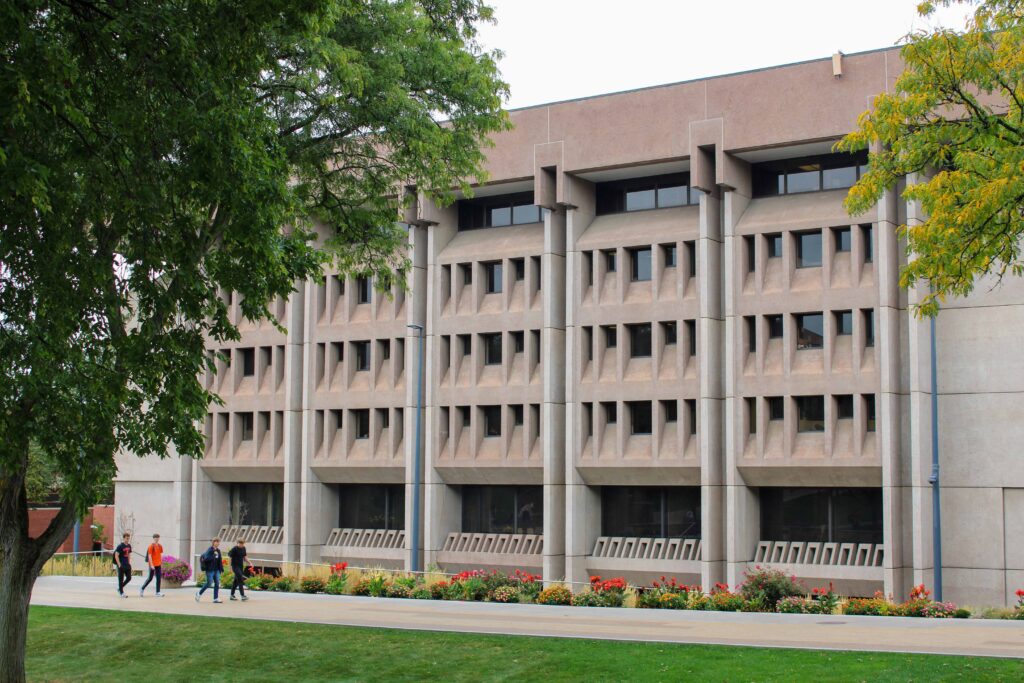
A crowd of mostly Syracuse University students, along with faculty, staff and administrators, gathered in Bird Library on Tuesday afternoon for “Academic Freedom Under Pressure: Faculty Perspectives,” a Banned Books Week panel on the growing threats to what professors can teach and research.
The panel, held in the Peter Graham Scholarly Commons, featured three professors: Thomas Perreault, DellPlain Professor of Latin American Geography; Roy Gutterman, director of the Tully Center for Free Speech; and Thomas Keck, the Michael O. Sawyer Chair of Constitutional Law and Politics.
The event was one of seven hosted by SU Libraries and the College of Arts and Sciences’ Department of English during Banned Books Week, which runs Oct. 5-9 and examines the history of book bans and censorship today.
While many of the most visible fights over academic freedom have played out at public universities in states like Texas and Florida, the panelists said those pressures can reach any campus. The panelists pointed to examples ranging from a Texas professor being told to cut Plato from his syllabus to federal funding threats and online harassment campaigns.
Perreault started the conversation by providing his definition of academic freedom. Academic freedom is not the same as free speech, he explained. It protects faculty members’ ability to teach and research within their area of expertise, “without fear of reprisal or coercion, or punishment based on your views.” Those protections also extend to graduate students, adjuncts, and others who teach, Perreault stated.
To draw the distinction, Perreault offered a hypothetical. “I could stand out in the middle of the Quad, screaming racial epithets,” he said. “That’s protected speech.” But it wouldn’t be protected by academic freedom, he argued, because academic freedom covers speech only that of which is grounded in scholarly expertise and relevant to the subject matter being taught.
Universities exist to serve the common good rather than those in power, Perreault said, but that doesn’t mean “anything goes,” since faculty still review one another’s work through peer review, hiring and tenure.
At SU, academic freedom is protected through the campus chapter of the American Association of University Professors, the university’s Faculty Manual and its 2024 Statement on Free Expression and Free Inquiry, as well as a Senate committee, which investigates complaints from faculty, adjuncts and graduate students who believe their academic freedom has been violated.
Continuing the conversation, Prof. Gutterman focused on legal history. He pointed to the landmark U.S. Supreme Court case Keyishian v. Board of Regents, in which a University of Buffalo instructor who was fired for refusing to sign an anti-communist loyalty oath challenged his dismissal and won in a 5-4 decision. In that ruling, Justice William J. Brennan called the classroom “peculiarly the ‘marketplace of ideas.'”
This is the idea that truth is best found when all ideas can compete openly, rather than when the government or another authority decides which ones are allowed.
“If we don’t have the marketplace of ideas live and in action in a college classroom or the quad, where in the universe are we going to have it?” Gutterman said.
He warned that censorship is a slippery slope, since ideas targeted today could become mainstream in a few years.
Panelists also addressed current fights over academic freedom. Thomas Keck pointed to Texas A&M University, where philosophy professor Martin Peterson was told to remove portions of Plato’s “Symposium” from his class over its discussion of love and gender.
“If we are banning Plato from university classrooms, I think we’ve really jumped the rails,” Keck said.
Keck ensured he is “reasonably optimistic” that federal courts will eventually protect professors’ academic freedom. He was less hopeful about book bans in public libraries, noting that a federal appeals court upheld the removal of several books from Texas libraries in Little v. Llano County, almost a year ago, in December 2025.
During the question-and-answer session, the panelists fielded questions on online harassment of professors and self-censorship on campus. While they offered clear views, they also admitted the issues aren’t always clear-cut, acknowledging gray areas in how academic freedom applies to real cases.
The discussion answered many questions but left others open; just as Perreault said, academic freedom is never settled. It is a principle, he said, that is “always being tested.”

is a digital producer for the NewsHouse.