
Onondaga Nation’s Indigenous Peoples Day Festival celebrates a living culture
Onondaga Nation’s Indigenous Peoples Day Festival celebrates a living culture
Vendors, performers and community members gathered to share traditions with the greater Syracuse community.
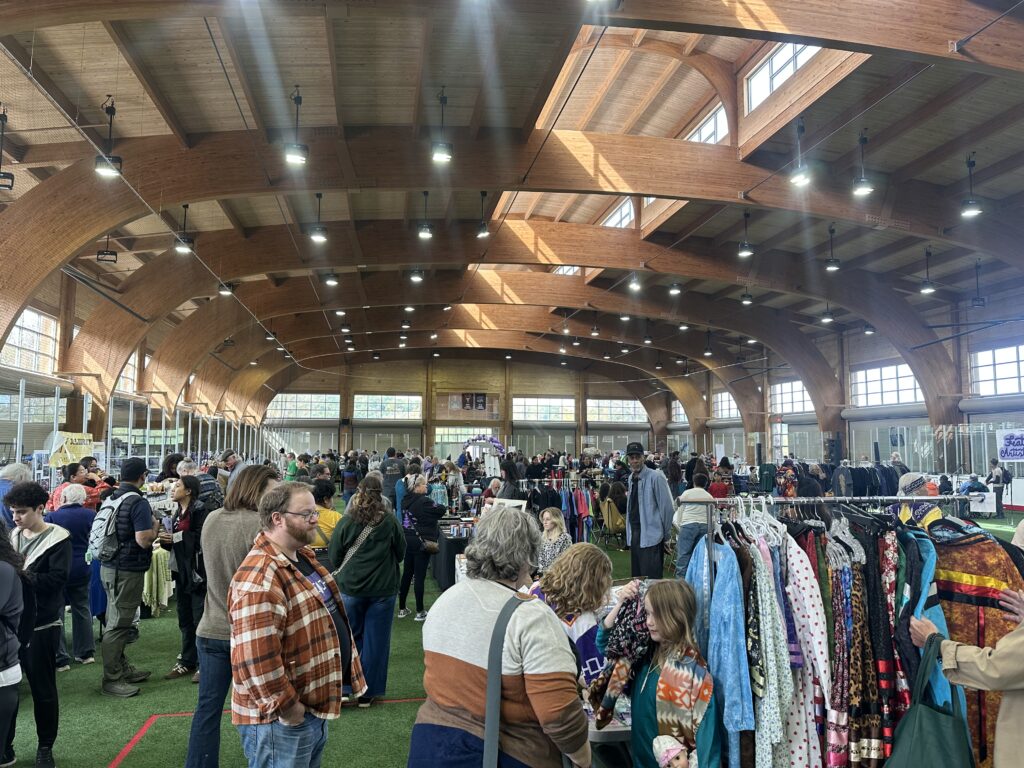
The melody of a flute reverberated like lightly blowing wind throughout the Tsha’ Thoñ’nhes Arena, the Onondaga Nation Fieldhouse. Attendees walked leisurely across the grassy turf to browse each vendor’s table, as laughing children weaved through the crowd.
The Onondaga Nation hosted the third Indigenous Peoples Day Festival on Saturday to unite the greater Syracuse community and Indigenous people in celebration.
“We’re giving our gifts in food and dance and singing, and what we can make with our hands,” Simone Gonyea of the Onondaga Nation Snipe Clan said.
As a community organizer, Gonyea searched her network to invite performers to the festival, such as the Haudenosaunee Singers and Dancers and their coordinator, Sherri Waterman-Hopper. Gonyea was the principal at the Onondaga Nation School, where Waterman-Hopper is a language teacher.
“It gives people an opportunity to learn that dancing is important and why,” Gonyea said.
Ahead of Indigenous Peoples Day on Monday, the festival featured Indigenous artisans, dance performances, featured artists, numerous food vendors, children’s activities, a sensory room and a nursery room.
The festival’s organizers were Onondaga Nation citizens, Neighbors of the Onondaga Nation and We of Italian and Syracuse Heritage, with major funding provided by the Central New York Community Foundation.
Victoria Lane of the outreach team at CNY Solidarity Coalition, a co-sponsor of the event, said that she hopes people see the “rich, beautiful culture that is still here in Central New York.”
Syracuse resident Jack Braunstein said that it’s a great privilege to live on Onondaga Nation territory in Syracuse.
“We always love every year to come to the Canoe Woman to get herbs to last us through the winter,” Braunstein said of Canoe Woman Herbs, one of the vendors at the event.
The Canoe Woman is Alicia Cook, whose original name is Guo Huiso, meaning “They help me with my canoe.”
“I blended the knowledge of Western modality with the traditional modalities, and that’s what strengthened me,” Cook said.
A licensed practical nurse who grew up in Onondaga, Cook works in Akwesasne in the Mohawk community’s traditional medicines program with healers and seers. Cook harvests plants from her own herb farm, the St. Lawrence River islands and the woods in the Adirondacks to make medicine. Cook said she hopes the festival helps attendees appreciate Mother Earth.
“We are neighbors, and we all have to start coming together for Mother Earth,” Cook said. “Because without her, where are you going to eat the plants?”
Many vendors have been honing their craft since childhood and are now passing down their skills to the next generation.
Wanda Wilson of the Mohawk Turtle Clan learned beadwork from her mother around age 7. Wilson said she hopes people appreciate the time that goes into handmade crafts.
“I don’t have a 9-to-5 job,” she said, “but sometimes I put in 50 hours making jewelry or beadwork all week.”
Karhatiron Perkins, a vendor in the Mohawk community from Akwesasne, said he puts “keys to our identity” in his artwork. He sells outfits from his clothing brand, paintings and handmade cowhorn rattles.
“I make them out of cowhorn, maple wood and I put popcorn on the inside. They’re that instrument they’re shaking,” Perkins said, pointing to the children in traditional outfits stomping to the rhythm of the cowhorn rattle.
Waterman-Hopper, the coordinator of the Haudenosaunee Singers and Dancers, said that dance is an important part of their Indigenous culture. Children of different nations and clans participate in the performances.
“That’s how it starts and it’s carrying on,” Waterman-Hopper said. “It’s not dying out. We’re not something of the past. We’re people that are continuing on in existence.”
After the performances, Onondaga Faithkeeper Oren Lyons ’58 spoke as a featured artist. Lyons was involved in the efforts to have the United Nations recognize Indigenous peoples. Syracuse University rededicated Oren Lyons Residence Hall in his honor in 2007. He was an SU All-American lacrosse goalie in 1957 and 1958.
At the festival, Lyons discussed his upbringing, the importance of community and Haudenosaunee values.
“Our symbol is a great tree of peace. It has four roots composed in the cardinal directions of the earth and designed to cover the world,” Lyons said. “We need that strongly today.”
Jerome Waterman of the Beaver Clan, who crafts wampum jewelry, and Tom Porter of the Mohawk Bear Clan were also featured artists.
Attendee Silverio Johnson, a postdoctoral scholar at SU, said that this festival was his first exposure to Indigenous arts and crafts.
“Coming here and seeing all of the beautiful dances and crafts and eating the good food just reminded me how every group does these things,” Johnson said. “We should all come together instead of being divisive.”
is a contributor to The NewsHouse.