
Bird Library’s new exhibit explores the changing face of Syracuse architecture
Bird Library exhibit explores SU architecture
The history-based exhibit, titled “Architectural Origins: Syracuse University Buildings 1870-1970,” will be on display until January 2026.
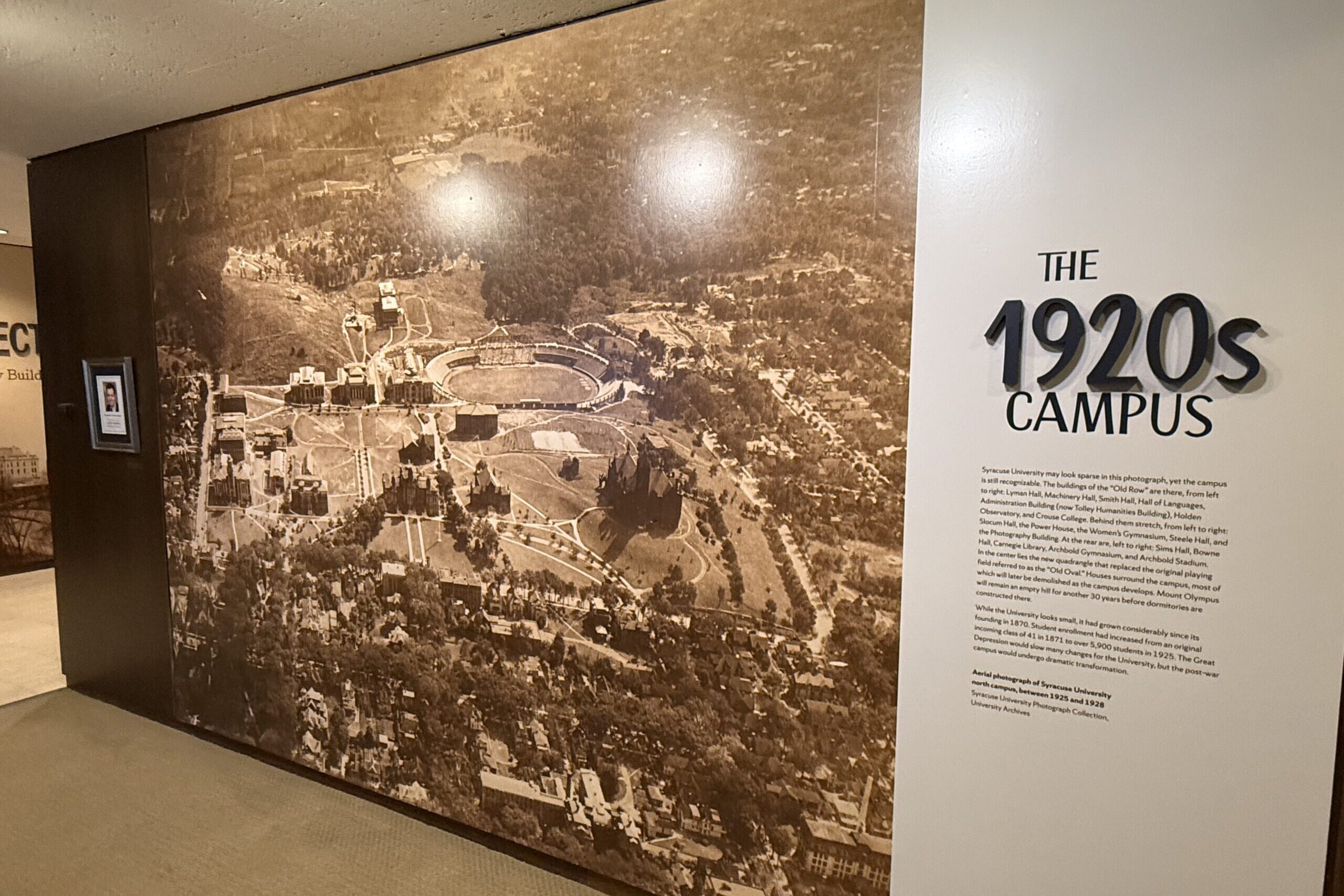
Have you ever stopped halfway across the Quad, stared at a random building and wondered, “Wait, how old is that building?” Well, Bird Library’s new fall exhibition tells you that and more, highlighting the mix of old stone towers, red-brick facades and modern glass that shape Syracuse University’s campus.
Now open for the Fall semester, the Special Collections Research Center’s (SCRC) exhibition Architectural Origins: Syracuse University Buildings 1870-1970, located in the sixth floor, takes a closer look at the evolution of the campus we walk through every day.
Students might notice the difference between historic halls like the Hall of Languages—Syracuse University’s first building, completed in 1873—and newer landmarks like the Bird Library. The exhibit traces those transitions, showing how styles shifted from Gothic to Georgian Revival to modern concrete and glass.
Meg Mason, an archivist at the SCRC, said that the exhibit is meant to help visitors discover new stories and historical details about buildings or notice something new about the history of the campus. To achieve this goal, she put together a wide range of materials.
“I wanted to provide a wide variety of formats and images in the exhibition to make it as interesting as possible,” Mason said.
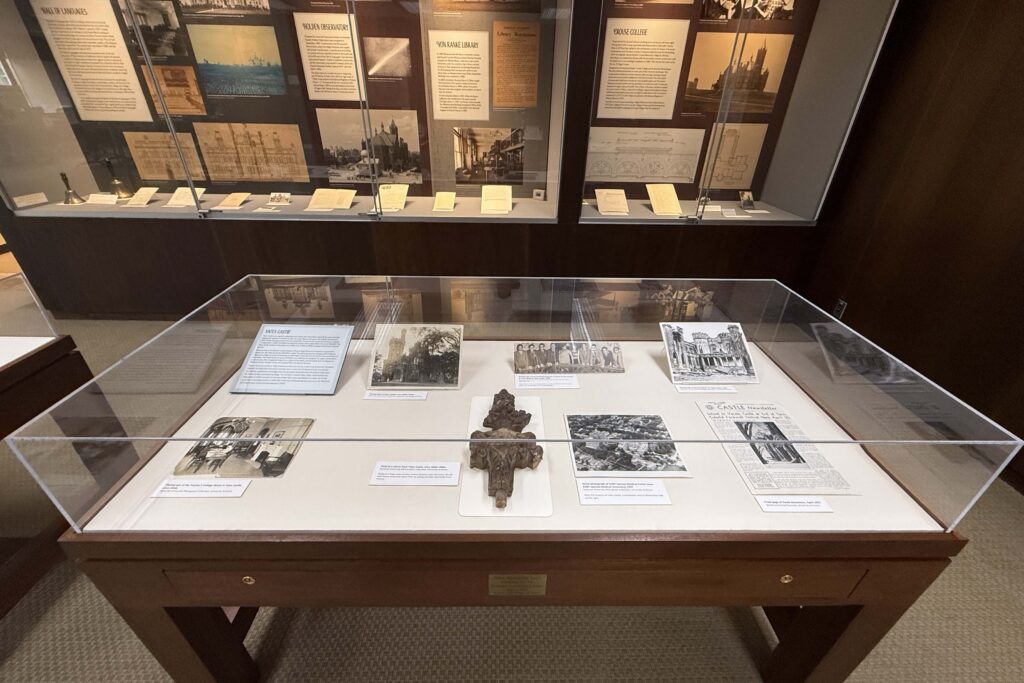
Alongside exterior photographs, she chose interior shots, construction images and even three-dimensional artifacts, like a student desk in the hall case, to balance out the “flat” materials.
“I didn’t realize until I saw some of the old drawings how much the campus has changed,” said architecture sophomore Keaton Field.
After visiting the exhibit, he said he became more aware of the intentional designs and architecture around campus. Slocum Hall, he said, once had a grand front staircase, which was removed when the street and bus stop were added.
The story of SU architecture is also a story of expansion—adding schools, residence halls and athletic facilities to keep pace with a growing student population. The exhibit shows that the Women’s Building, now home to fitness and wellness programs, was once a groundbreaking step toward recognizing women’s place on campus.
For many students, the exhibit connects the present to the past in interesting ways.
“I’ve had classes in both Sims Hall and Newhouse,” said biology sophomore Julia Bruno. “Walking between them feels like walking between two completely different eras.”
“This exhibit really shows why that is,” Bruno added.
Some of the most compelling objects Mason included highlight buildings that no longer exist.
“I like the 1943 photograph of Yates Castle nestled right up against Weiskotten Hall,” she said. “The castle no longer exists, so images show you exactly where it was located from an aerial perspective and also give you a sense of why it was included in the transfer of land to the State of New York.”
Another favorite of hers is a handwritten 1871 agreement to build the Hall of Languages, signed by the contractor.
“It’s such a simple document, torn at the top edge, but it tells you so much about the construction of our first building on campus.”
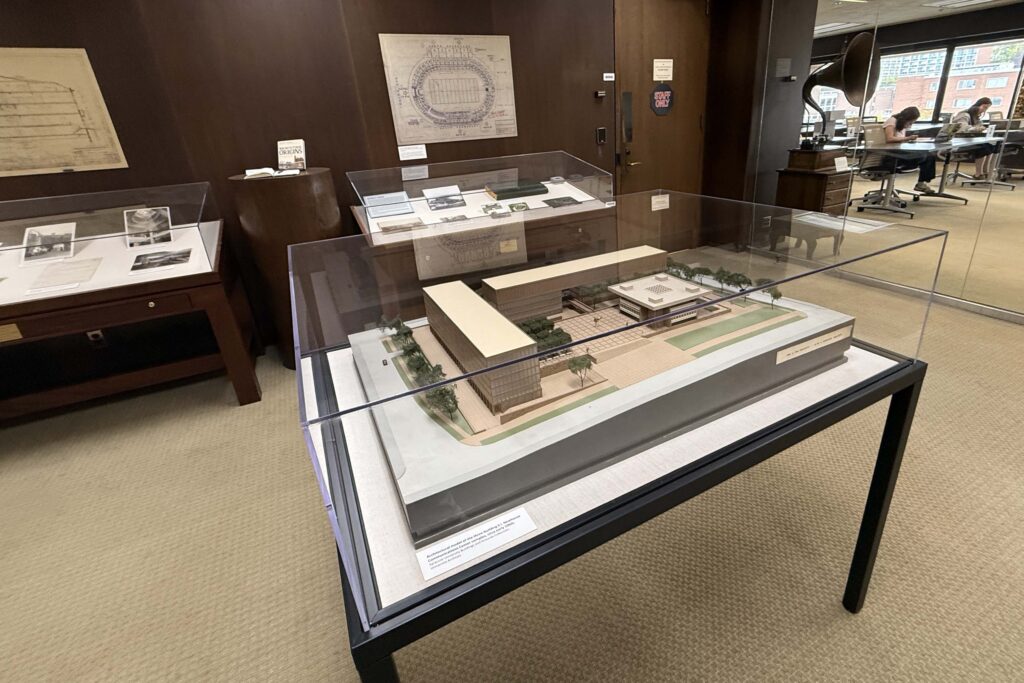
The exhibition itself is a time machine. Visitors can flip through historic records, photographs and postcards, examine century-old architectural drawings and plans, and even spot unexpected artifacts—like a piece of a bleacher from Archbold Stadium and I.M. Pei’s architectural model of the Newhouse School of Communications complex.
Freshman Liz Holt said she appreciated how the exhibit gave her a different perspective on her first semester at SU.
“Seeing this exhibit made me feel like I’m part of a bigger history. It makes campus feel less intimidating and more like home,” Holt said.

is a contributor for The NewsHouse.

is a Digital Producer for The NewsHouse.