
‘Don’t worry — I was you last year.’: How international students find belonging at SU
How international students find belonging at SU
Students far away from home navigate social challenges to build community.
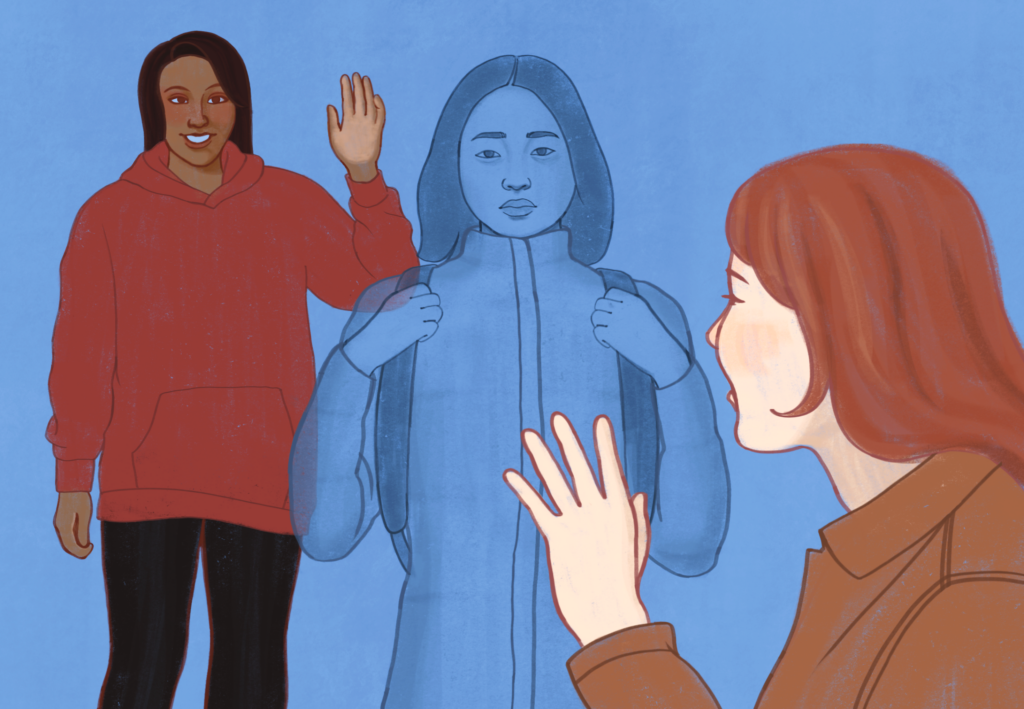
On a freezing January evening, the dining hall windows at Ernie Davis reflected streaks of snow under the yellow glow of campus lights. The sound of clattering trays echoed through the room. A group of students debated basketball scores; a fork slipped from someone’s hand and clinked on the table. Zhiyuan Huang kept his eyes on his plateful of curry rice, now dry and cold, stirring it slowly while the voices around him blended into static. Outside, students hurried in groups, laughing, brushing snow from their sleeves.
Huang looked up for a moment and realized he hadn’t spoken to anyone all day.
“I used to think I liked being alone,” he said later. “But being alone here feels different—it feels like disappearing.”
The numbers behind the quiet
Across the United States, stories like Huang’s have become more common. The quiet isolation he describes isn’t just a private feeling — it reflects a growing concern among international students: whether they will find connection at all. Increasingly, that concern is shaping who chooses the U.S. in the first place. After years of pandemic disruption and political uncertainty, international student enrollment has not rebounded and continues to face decline. Nearly 20 percent fewer international students traveled to the U.S. in August compared with the previous year, according to an October 2025 report by The New York Times, with arrivals from Asia falling by 24 percent — the steepest decline since the pandemic.
At Syracuse University, staff at the Center for International Services say international enrollment has seen at least a double-digit decline since 2019, a period that has also seen significant staffing reductions within the office itself, a shift felt across campus: smaller English classes, fewer international club events, quieter cultural nights. For many students, fewer peers also means fewer people who understand what it feels like to start over in another country.
“The policy and political climate of the last few years absolutely changed how students view U.S. education,” said Wei Gao, former Associate Director for International Services at SU and now Associate Dean of Students at Cornell University. “What used to be a dream destination has become a more cautious choice. Students now ask, Will I feel safe? Will I be understood?”
Finding footing in a colder place
When Huang left Suzhou, Jiangsu, for Syracuse in 2022, he expected academic pressure, not emotional distance. During his first winter, the cold didn’t just seep through his coat — it followed him indoors. “People were friendly,” he said, “but the conversations stopped at ‘How are you?’”
Most days, Huang found a quiet corner by the Bird Library entrance, where footsteps never stopped and voices carried from every direction. He didn’t join the conversations, but sitting there, he felt the pulse of the campus — the rush, the noise, the warmth. “I didn’t talk to anyone,” he said, “but sitting there made me feel a little less alone.”
That spring, Huang joined WeMedia, a Chinese student-run publication that covers campus stories and social trends. Late at night, he and a few others would sit in the Newhouse lounge editing articles, switching between English captions and Chinese punchlines. “It felt good to speak my language again,” he said. “To make something that other students actually read.”
A few months later, he joined the Badminton Club, one of the few places where international and American students mixed naturally. “When you play, you don’t need perfect English,” Huang said. “You just laugh, cheer, and high-five — that’s enough.”
Belonging, for him, came not in grand gestures but in moments: a classmate saving him a seat, a shared umbrella during a rainstorm, a friend noticing he hadn’t eaten lunch. “You start realizing you’re not invisible,” he said.
Learning to speak up
For Xingrui Feng, now a junior in the College of Arts and Sciences, belonging started even before his first semester began. He entered Syracuse through a conditional-admission program that let him complete first-year coursework online at Shanghai Jiao Tong University while preparing for full enrollment. In May 2024, he arrived in Syracuse for the English Language Institute (ELI) summer program — his first time in the U.S.
“The first week, everything was confusing,” he said. “Even ordering at Subway was stressful. They spoke so fast — I didn’t know what half the toppings were.”
At a Subway near Marshall Street, Feng froze when the cashier asked, “Cheese and toasted?” He nodded quickly — only to end up with double cheese melted into the wrong bread. “Now I just point at the menu and hope for the best,” he said.
At ELI, Feng found what he called a “safe start.” The small classes and conversation workshops paired students by comfort level rather than fluency. “Everyone was nervous, but we were nervous together,” he said. “We helped each other with everything — opening bank accounts, finding housing, even where to buy rice.”
By fall, he already had a small circle of friends who met for drinks at Salt City Coffee and swapped stories about language mix-ups. “The funny thing is,” he said, “the more you talk, the more people listen — even if your grammar’s wrong.”
Tula Goenka — a longtime professor in Television, Radio and Film at Newhouse, and an international student herself when she first came to the U.S. in the 1980s — said she sees that same hesitation every semester.
“Adjustment is always hardest in the first few months,” she said. “Even when students speak English well, American students talk incredibly fast. It takes time to catch the rhythm.”
For many students, she said, the real challenge isn’t ability — it’s confidence. “International students often stay quiet because they don’t want to look like they’re struggling,” she said. “But when they don’t ask questions, domestic students assume everything is fine, and the gap widens.”
Students with stronger confidence in English reported significantly lower levels of loneliness and anxiety, a finding from a 2025 research study by Ada John that Feng recognized in himself. “Once you start talking,” he said, “you stop feeling invisible.”
He now volunteers occasionally at ELI as a peer conversation partner, not out of obligation but gratitude. “Sometimes new students just need someone who knows what they’re trying to say,” he said. “I tell them, ‘Don’t worry — I was you last year.’”
Fitting a social rhythm
For Dohun Kim, a senior from South Korea majoring in Sport Management, the hardest part of coming to Syracuse wasn’t language or weather — it was understanding how to connect with people. “Everything felt unfamiliar at first,” he said. “Even small things, like how casually people interact or how quickly they form groups, made me wonder whether I belonged.”
Kim lived in Day Hall during his first semester, surrounded mostly by domestic students. He tried to join conversations in the hallway and common room, but the cultural rhythm felt just a beat too fast. What helped, he said, was his roommate — an outgoing student who was rushing a fraternity and seemed to know everyone on the floor. “He introduced me to people, brought me into conversations,” Kim said. “Those little things made the first few months feel less overwhelming.”
As he settled in, Kim joined the Syracuse Women’s Soccer team as a student manager. “Once I had something I was contributing to, I felt like I had a place on campus,” he said.
Still, Kim said many international students share the same worries he once had: whether they’ll fit in, whether domestic students will understand them, and even what declining university ranking means for their future. “A lot of us try really hard to integrate,” he said. “But sometimes the social circles are already closed before we get here.”
Kim said Syracuse offers support, but not always in the ways international students need. “There’s a gap between what the university provides and what we actually look for when we’re trying to fit in,” he said. “Most of us figure things out on our own.”
Even so, he tries to reassure new students when he can. “It’s normal to feel lost,” he said. “One good connection can change everything.”
A broader lens on belonging
Adjusting to life at Syracuse often proved more challenging socially than academically — a pattern Chimdi Onyeama experienced firsthand. A 2025 Syracuse graduate with a degree in advertising, Onyeama came to the U.S. from the U.K. expecting cultural differences, but she didn’t anticipate how subtle and coded everyday interactions on an American campus could feel.
“Social norms were the biggest shock,” she said. “People were friendly, but I wasn’t always sure when something counted as a real connection. It made me realize that belonging isn’t automatic here — you have to learn it.”
Food was an early hurdle. “It sounds small,” she said, laughing, “but the food took getting used to. It makes you realize how far from home you really are.”
Classroom life, however, felt familiar. Participation, group work, and professors’ expectations weren’t dramatically different from what she knew in the U.K. It was outside class—hallways, clubs, weekend plans—where the invisible distance appeared.
Onyeama built a few close friendships with American students, but she said it didn’t happen naturally. “A lot of American students haven’t lived outside the country,” she said. “They’re not trying to exclude anyone, but they don’t always understand what international students are carrying.”
Most of her early moments of belonging, she said, came from other international students or clubs where people shared similar experiences. Barnes Center counseling also became an unexpected source of support. “It helped,” she said simply.
The quiet crises
Over time, the social isolation and adjustment pressures many international students describe don’t just shape daily interactions — they accumulate quietly. Dr. Brandon Koscinski, a psychologist at Syracuse’s Barnes Center at The Arch, said that international students often internalize stress until it becomes overwhelming. “In many Asian cultures, mental health isn’t something you go to a doctor for,” he said. “Students may see anxiety as weakness rather than a normal part of adjustment.”
He described what he calls quiet crises — students who appear successful on paper but feel disconnected in daily life. “They’ll tell me, ‘I’m fine,’ but then mention they haven’t eaten with anyone all week,” he said. “That loneliness builds slowly, like snow piling up overnight.”
More than 60 percent of surveyed international graduate students delayed seeking counseling due to fears of being misunderstood or appearing “too emotional,” according to a 2025 research study. Koscinski said that pattern is visible at Syracuse too. “When they finally come in,” he said, “the first thing I tell them is: it’s okay not to be okay.”
For Huang, that message hit home. After months of trying to “tough it out,” he attended a Barnes Center workshop on coping with culture shock. “I thought it was just me,” he said. “But hearing others talk about the same thing made me feel normal again.”
Building bridges
Community support, Gao said, is what keeps international students from slipping through the cracks. During her time as Associate Director for International Services, she worked closely with the Chinese Students and Scholars Association (CSSA) and the Chinese Union (CU) to strengthen peer support systems.
Her approach combined information with empathy. She helped coordinate information sessions on housing, taxes, and visas, while also advising student leaders on how to host inclusive cultural events. Under her guidance, CSSA partnered with the Barnes Center in spring 2024 to create a bilingual stress-management workshop — the first of its kind on campus.
“International offices can’t just process paperwork,” Gao said. “They have to build trust.”
Many of these programs remain student-led today. CSSA’s Mid-Autumn Festival Gala and Spring Festival Gala draw hundreds each year, offering food, music, and the familiar warmth of home.
At this year’s Mid-Autumn Gala, held on October 5, paper lanterns glowed across Goldstein Auditorium. The air smelled of mooncakes and tea. On stage, Chinese students performed a mix of pop songs and traditional dance; in the aisles, friends passed dumplings wrapped in napkins.
“It’s loud, messy, familiar,” Huang said, smiling. “Like home.”
Gao believes these connections — the student-led cultural events, the bilingual workshops, and the everyday support networks built through groups like CSSA and CU — are as important as any academic achievement. “You can’t fix loneliness with a policy,” she said. “But you can create community — one conversation, one dinner, one shared laugh at a time.”
Belonging as a process
By late spring, the snow outside Ernie Davis had melted into muddy grass. Huang no longer sat by the window alone. Between WeMedia meetings, badminton matches, and CSSA planning sessions, his calendar looked almost too full. “Last year, I was the one looking lost,” he said, smiling. “Now I’m helping the new ones find where to go.”
Across campus, students like Huang and Feng are shaping a quieter, steadier kind of belonging — one built not from numbers or policies, but from conversation, empathy, and the courage to reach out.
“We all come here for opportunity,” Huang said. “But what keeps you here is people.”

is a digital news producer for The NewsHouse.

is a contributor for The NewsHouse.