
Financial outlook, mail-ins and access: How and why SU students voted this election season
How and why SU students voted this election season
Jobs, money and voting methods were top of mind among Orange Pulse’s 119 respondents leading up to Election Day.
Entering the midterm elections, most Syracuse University students surveyed say they are concerned about money and economic issues, and most mailed in their ballots.
An Orange Pulse survey of 119 students in the final week of the election showed that 82% of respondents listed the cost of living as a primary concern entering this election, followed by the job market at 74%.
Two-thirds of respondents mailed in their ballots, while only one in eight submitted their vote in person. About one out of five students said they didn’t vote at all.
College students vote with future in mind
As Election Day approaches, college students in New York await the decision to see who will lead state government as they begin their new lives in the real world as they try to balance what matters most for their futures.
For television, radio, and film senior Colin Harkins, the impact on voting comes more from trying to prevent the chaos.
“Right now, I feel like I’m less voting for something and more voting against something,” Harkins said.
Hailing from Wayne, Pennsylvania, Harkins said the cost of living is extremely important, noting just how important this issue can become for graduating students.
“It’s something everyone our age is thinking about,” he said.
Education and psychology senior Morgan Tomlin said she feels similarly to Harkins about the cost of living.
“This is especially concerning for young adults who are graduating college, starting careers, and trying to become financially independent,” Tomlin said.
The Charleston native also wants her vote to reflect her concerns about safety.
“I think everyone deserves to feel safe in their own community. Whether someone is walking home at night, going to work, or spending time with their family, I don’t think they should have to worry about their personal safety,” she said.
– Tommy Moe and Cameron MacLennan
Were students as motivated to vote as they were in 2024?
With the 2026 midterm elections, voter motivation among Syracuse students appears to be more complicated than it was during the 2024 presidential election. Interviews suggest that some voters feel less urgency to participate this time around, largely because they perceive the stakes to be lower.
SU senior Nick King pointed to how presidential elections often generate greater public interest because of the visibility and influence associated with positions like president and vice president.
“I think people are generally more motivated to vote on higher profile positions.”
Midterm elections, by comparison, can struggle to capture the same level of attention. Some voters also question how much congressional representatives can directly impact their everyday lives, potentially making them less motivated to head to the polls.
For SU sophomore Jacob Berr, the motivation was there, but the opportunity to vote was lost after his mail-in ballot was accidentally thrown away.
“I think it’s very important to vote,” Berr said. “Had I been able to, I definitely would have.”
Despite those individual experiences, the overall survey results paint a somewhat different picture. Of all respondents, 30% said they were unable to vote, while 40% said they were just as motivated to vote in the 2026 midterms as they were in 2024. Another 30% said they were less motivated this time around.
The results suggest that declining enthusiasm is not necessarily universal. While some voters may view midterms as less consequential than presidential elections, others remain equally committed to participating in the electoral process.
“It’s a privilege to be able to vote, and so if people can, they should,” Berr said.
– Nick Evans and Kelsey Jones
Two factors that sway students to show up
Some students believe location and the way voting is encouraged play an essential role when it comes to voting.
SU senior Muaz Parvezn explained how voting is much more accessible at home in New York City because of how many polling places there are. In comparison, Parvez said Syracuse was not as accessible or active in promoting voters to go to the polls.
“I really didn’t see anything about voting except social media where everyone is posting stuff, but that’s it,” Parvez said.
However, junior Maliha Mehjabin, also from New York City, said it was very accessible for people to vote in Syracuse. However, Mehjabin’s hesitancy came from the manner in which voting was promoted.
“They’ll shove a paper in your face and be like did you vote? Did you vote… and they don’t reply or talk about how to transfer that or if you can vote here in Syracuse and then go back and vote again,” said Mehjabin.
– Zaara Malik and Noah Schuler
Democracy in under 30 minutes
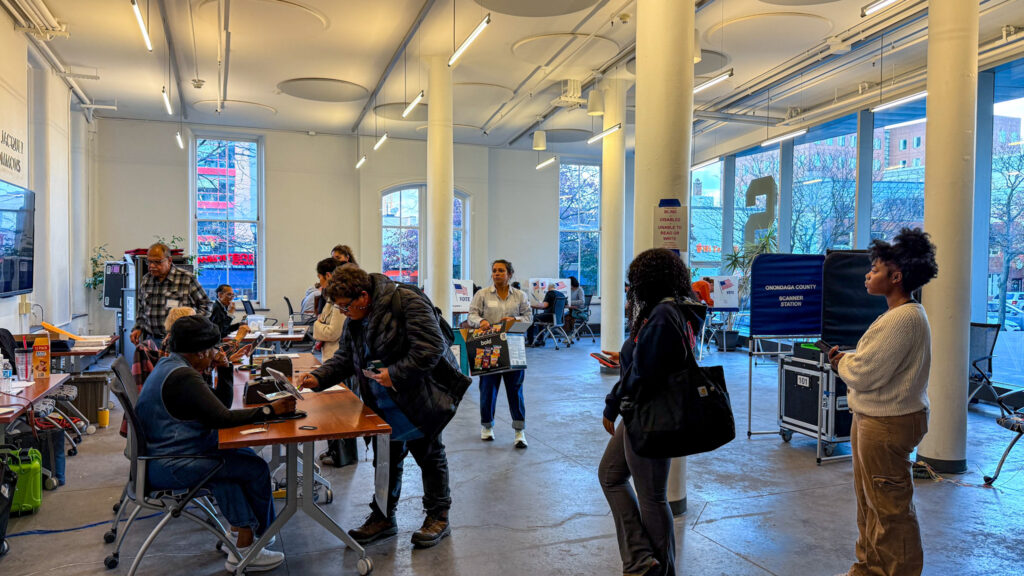
Syracuse University students Alexa Krein, Rachel Oppenheim, Matt Weinstock and Bashir Diyire are all from New York, but they approached the 2026 midterm elections differently.
Oppenheim was the only one who didn’t vote.
“I know it’s not good,” Oppenheim admitted.
Krein voted because having a voice in democracy is important, she said, “especially in 2026, when there are so many controversial things happening in the world.”
Weinstock and Diyire, both juniors, voted in-person and said the process was quick and easy.
Diyire said it took him only 10 minutes. Weinstock went home to Westchester County to vote early.
“It went pretty fast, probably under a half hour,” he said.
– Annabel Metzger and Elliot Harris
Does voting matter?
Does one vote really make a difference? For many Syracuse University students, the answer is yes, but where they live may influence just how much they believe their vote matters.
Interviews conducted by NewsHouse suggest that a person’s perception of their voting power can depend, in part, on their state’s political landscape. Residents of non-swing states, such as SU senior Andrew Forster, who lives in Connecticut, may feel their votes carry less weight because of the non-competitive nature of elections.
“I live in a state where races are not particularly close,” Forster said.
Geography, however, does not tell the entire story. SU graduate student Kiara Brielle-Haden strongly emphasized that every vote in a democracy holds equal value, regardless of where someone lives or how competitive their state may be.
“If we have an opportunity to have a say, we should absolutely take it,” she said.
The survey results reinforce that sentiment. Of the 119 people surveyed, only 10% rated the importance of their vote between one and three on a 10-point scale. Meanwhile, 46% rated their vote’s importance between four and seven. Another 30% gave their vote the highest possible rating of 10.
Together, those numbers suggest that most respondents believe their vote matters at least somewhat, with a significant portion expressing strong confidence in their individual voting power.
Ultimately, the findings highlight an important distinction between how much people believe their vote can influence an election’s outcome and how much they believe their participation matters in a democracy.
“Throughout history, not a lot of people have [had the right to vote], so exercise that right now,” Brielle-Haden said.
– Nick Evans and Kelsey Jones
Fueling the conversation around voting
After talking to students on campus about how prominent voting is in their friend groups, it is clear that their social approach is heavily influenced by social media, and for some, the topic doesn’t come up at all.
“Voting isn’t a prominent topic at all, there’s no discussion around it. If we talk about it at all, it’s more in a joking sense because of something we saw on social media,” finance senior Leo Schwartz said.
Schwartz described something similar to others: unless there is a real purpose or prompt, voting won’t normally make its way into conversation.
The way the newest generation of voters is informed about the election is also inextricably tied to social media. Responses to the Orange Pulse survey showed that the overwhelming majority of students get their election info online, with a near even split between social media and news outlets. According to junior Brayden Burman, the way students get their election info starts on social platforms.
“There’s a lot of stuff that you see just being on a college campus with ads and posters and stuff like that. It’s a lot more just trying to get people to vote with the things you see on campus, but for getting actual information about candidates and stuff, I see links and stuff on social media,” Burman said.
– Matt Streicher and Jack Feldman
