Rose laying ceremony emphasizes the importance of community
Rose laying ceremony emphasizes community


At exactly 2:03 p.m. the doors of the Hall of Languages opened. 35 students emerged, each carrying a white rose, and proceeded down the hill toward the Wall of Remembrance. The unassuming, stone semicircle that people rush by each day was now at the center of a close-knit crowd of students, faculty and families that stretched back up the hill, nearly to the steps of the building from which the Scholars emerged.
The event began with the procession of students holding white roses in their hands. Once each student made it to their assigned position, the Syracuse University Choir the chore of the university sang in a gentle tone.
This procession marks the beginning of the annual Rose Laying Ceremony–a tradition held at the end of Remembrance Week to honor the 35 Syracuse University students and 11 residents of Lockerbie, Scotland who were killed in a terrorist attack on Pan Am Flight 103 in 1988. This year marks the 30th anniversary of the attack, which took place on Dec. 21 at 2:03 p.m., and resulted in the deaths of all 270 men, women and children on board.
After brief remarks, each Remembrance Scholar was given the opportunity to read a small passage about the student they represent. The Scholars have spent months getting to know them by reading diaries and letters, speaking to family members and friends, and researching their student’s involvement on campus. Some fought back tears while recounting their student’s unfulfilled aspirations. Others made the assembled crowd chuckle with absurd anecdotes. Each ended their time with “I lay this rose on behalf of…and act forward in [his/her] honor.”
Lockerbie Scholars Joseph Holland and Harriet Graham spoke on behalf of the people and town impacted by the attack. “We remain as we have always been since that fateful night – a community of strong and kind people who can work together in the face of adversity,” Graham said.
The ambiance during the ceremony was a heavy one. Members of the SU community became emotional throughout the event– leaning on each other for support.
After the roses were laid, anyone else affected by the attack was invited to place flowers along the wall. Men in military uniforms and kilts–several of whom were first responders on the ground in Lockerbie, stepped up with colorful bouquets alongside elderly men and women, and young children — the surviving family members of the SU students who were killed.
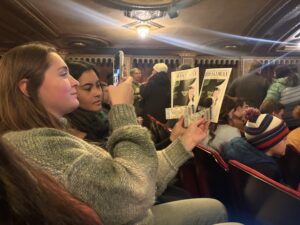
Biotech freshman Mitchell Vargas was among the public trying to find a spot with a good view of the ceremony.
Family members of some of the victims were present as well. Jen O’Keefe traveled with her family, including her grandparents, uncles and parents, from Albany. O’Keefe attended to honor her aunt, Lynne Hartunian, who was one of the victims killed in the bombing.
“I feel sad, but it’s nice that Syracuse has this event to remember and show respect to all the victims,” O’Keefe said. “My parents and grandparents always told me to remember all the positive things from her, she was positive, lovely, spiritual and ongoing.”
“I went to the event on Sunday in Hendricks Chapel and I felt like I needed to come to this one,” he said. “It brings up mixed emotions. It’s a sad event, but to see how it brings the community together and all these people in here makes me feel good.”
After the ceremony, SU alum Bronte Schmidt broke down in tears. Last year she represented Theodora Cohen, but says, “It’s not something that ends once the program ends–it’s something that you carry with you for your entire life.”
This is certainly true for Nancy Keefe Rhodes, who was in the graduate program studying social work at SU in 1988. “You can hear in my voice that it affects me now,” she said, fighting back tears. “It’s really important that we never forget this.”
Rhodes, who still lives in Syracuse, made a point to come to campus for the Rose Laying ceremony. She remembers the art installations, speakers and panels that the university community created in response to the attack three decades ago, as well as when the Remembrance Scholar program was created to help the community heal.
“I think we always struggle for the right words, we always struggle for [did] we get it right?” she said. “And really the effort to say anything as a community is what does it justice.”

is a senior studying Newspaper/Online journalism. Particularly the online part these days. She’s also a semi-frequent contributor to The NewsHouse who would love for you to follow her Instagram and subscribe to your local paper.