How social media is rewriting the protest song
How the protest song is changing
From Springsteen to TikTok creators, the Minneapolis ICE protests have ignited a new wave of political music.
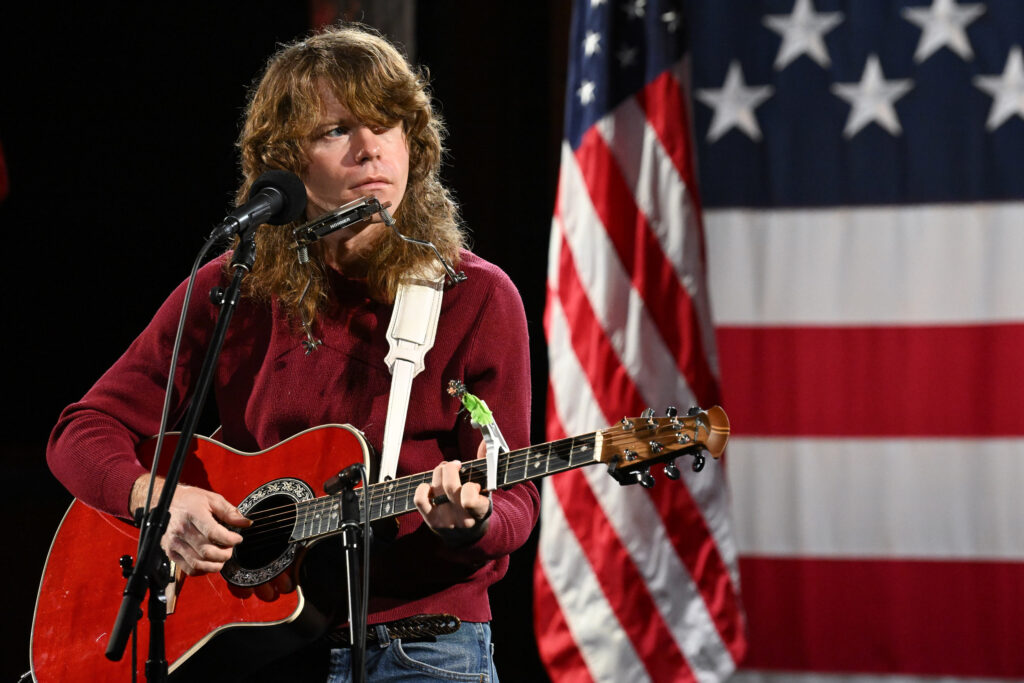
On Feb. 1, an estimated 2,000 people gathered outside a Minneapolis hotel where federal immigration agents were staying and sang “It’s Okay to Change Your Mind” directly at the windows. Videos of the action spread across TikTok within hours, drawing over 20 million viewers from across the country. Many of them were pulled into the music itself as a form of protest.
That moment, organized by a Minneapolis network called Singing Resistance, represents something Paula Harper, who has a doctorate in historical musicology and studies music, sound and the internet at the University of Chicago, has been tracking for more than a year. Harper argues that the protest song hasn’t disappeared; it has migrated.
@nowthisimpact Thousands of Minnesotans gathered outside hotels where ICE and Border Patrol have been staying to sing to them, encouraging agents to quit and stop the ICE terror on their streets. Song by: Annie Schlaefer & @singingresistancetc on IG (via: Reddit / CorleoneBaloney)
As ICE operations in Minneapolis have intensified, two residents, Renee Good and Alex Pretti, were killed in January.
This sparked a surge in politically charged music. Recent releases include Bruce Springsteen’s “Streets of Minneapolis”, the Dropkick Murphys’ “Citizen I.C.E.”, and U2’s “American Obituary.”
In today’s world, grassroots music circulates widely on social media. Small creators are rebuilding the protest song from scratch. In doing so, they are redefining what protest music means in real time.
“If you are trying to say something timely and specific and critical about what’s happening, and your medium is music, the place to participate in discourse is not going to be the music streaming platforms,” said Harper. “It’s going to be short-form video platforms.”
Harper, who presented new research on the contemporary protest song in the TikTok era at a conference last weekend, pointed to a TikTok creator known as @agiftfromtodd. Their song “Hostile Government Takeover” began as a simple post shortly after the second Trump inauguration, then picked up a full EDM beat from another user and spread. She explained this interaction illustrates how short-form video platforms enable the same kind of collaborative process that once defined protest music.
Jesse Welles, an Arkansas singer-songwriter with 2.2 million followers on Instagram and 1.5 million followers on TikTok, has built his audience almost entirely through short, snappy folk songs responding directly to various news headlines. His lyrics talk about a variety of issues from immigration, healthcare and corporate power. His song “Good vs. ICE” went up the day after Renee Good was killed.
Theo Cateforis, an associate professor of music history at Syracuse University, sees something historically familiar in all of this. He traces a line from the Civil Rights Movement through Vietnam and the Iraq War era to what is unfolding on TikTok today. The current moment is a return to the folk tradition that predates the radio era.
“In some respects, this was returning precisely to the folk movement,” Cateforis said. “Individuals who just had a creative impulse and needed to voice their frustration.”
For Cateforis, protest songs are defined by perspectives of “us v.s. them.”
“They often inherently have sides in mind,” he said. “Us are the people singing the song and the people bringing attention to inequities of power, social injustices. Them on the other side is often the people causing the problem.”
In a media environment fragmented into niche streaming ecosystems, modern protest songs can be guilty of “preaching to the choir” more so than in the 1960s, when protest music from the Civil Rights Movement and Vietnam era reached a shared audience through radio stations. But Cateforis argues the choir has simply moved.
“It makes us feel less alone and atomized when you see someone else giving voice to similar feelings that you have,” he said.
Harper explained that there are two different terms for types of politically charged music. Music that centers around collective performance and group dissent is what one would think of as “protest music” rather than “timely political music.” Singing Resistance operates in that tradition; for example, their songs are designed for crowds, stripped down and easy to learn in a parking lot or on a sidewalk. Springsteen, she noted, is writing in a different medium.
“There is a history of protest music that is meant for going to protests and singing along at protests,” Harper said, with qualities “different from a rock song made for the airwaves, which is what Bruce Springsteen is good at making.” It is telling that the song’s closing chant, “ICE Out Now,” is the main piece that has traveled into protests.
The platforms themselves are not entirely neutral. Harper described cases where TikTok suppressed audio connected to politically charged moments. In one instance, the platform muted the Italian anti-fascist song “Bella Ciao” due to its connection with the assassination of conservative commentator Charlie Kirk.
“They’re going to take down something that is perceived as being celebratory over an act of violence,” said Dr. Harper.
The creators themselves are clear-eyed about their role within such movements. Dr. Harper described their posture as less “we will change the world” and closer to a compulsion.
“I couldn’t not do something,” she said, paraphrasing the musicians she has interviewed who reasoned the need to create protest music. “Even if I’m skeptical of moving the needle, I might as well try.”