
Shoot for the moon
Shoot for the moon
In a world of transformation videos and the pressure to “looksmaxx,” injectable peptides are becoming a social norm for young men.
Editor’s Note: Some sources for this story asked not to use their real names. They are marked with an asterisk.
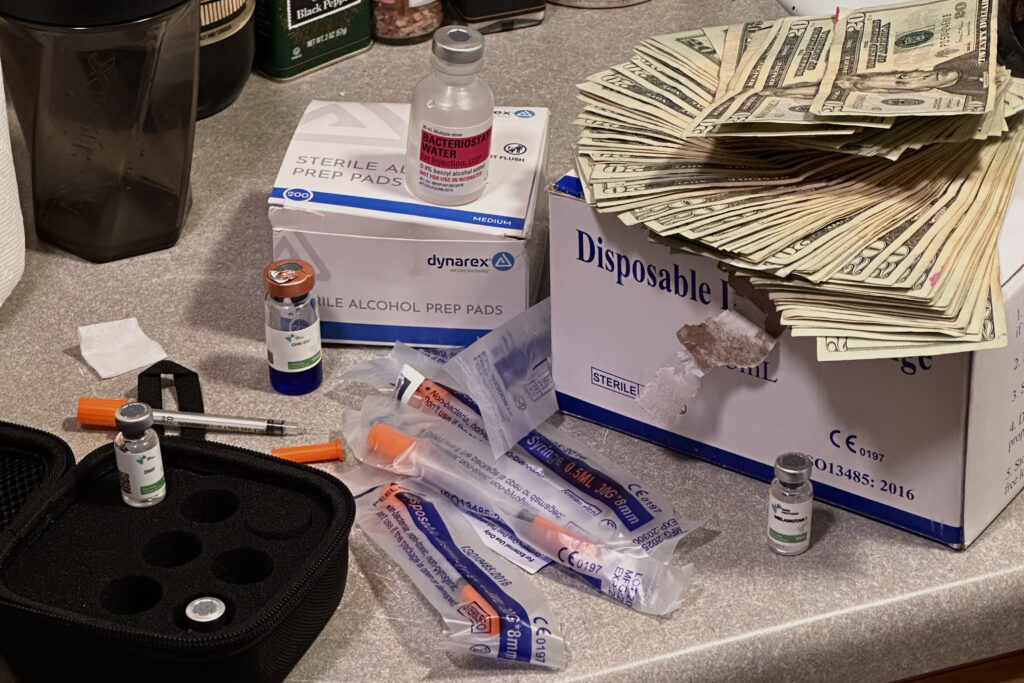
William* sticks it in his butt. It’s his injection site of choice today. He hasn’t brushed his teeth yet. Hasn’t checked his phone. He reaches into the mini fridge beside his bed, pulls out a vial of bacteriostatic water and whatever peptide he’s chosen for the day, and injects before he’s even fully awake. Forget a shot of espresso. Nothing says good morning like a 31-gauge syringe, an alcohol swab and 250 micrograms of gray-market peptides slipping just beneath the skin.
Today’s pick is MT-1, better known as Melanotan-1, a non-FDA-approved peptide that stimulates melanin production and promises a kind of manufactured glow. William orders them from China in large supply, then ships them off to Janoshik, a testing facility based in Prague. They’re returned with COAs and purity tests. That’s how he knows they’re real. Or at least real enough.
Melanotan isn’t some cartoon villain of a drug. Neither are Retatrutide, TB-500 or GHK-CU, three other popular peptides now found in dorm rooms and teenage bedrooms. They’re just short chains of amino acids, biochemical text messages telling the body when to burn fat, grow muscle or regulate blood sugar. GLP-1 drugs like Ozempic and Wegovy are peptide-based, but they’re FDA-approved medications backed by clinical trials. The peptides mentioned in group chats and online forums are experimental compounds often not approved for human use, sold online by research suppliers and injected with little or no medical supervision.
The irony of the peptide boom among young men is that many of the compounds they’re injecting are synthetic peptides meant to mimic signals the body already produces naturally, often at peak levels in early adulthood. Others are entirely foreign experimental compounds. The problem isn’t always what they’re injecting. It’s the unregulated market that sells certainty, and the way young men are learning to use these compounds from each other with no medical guidance.
Peptides have migrated from endocrinology offices to TikTok feeds, where young men trade dosing protocols like fantasy football stats and post transformation videos set to trending audios. Vials labeled “for research purposes only” arrive from overseas suppliers, then get repackaged in group chats as shortcuts to sharper jawlines, washboard abs and maybe even a hot new girlfriend.
Regulators have been trying to keep up with the surge in peptide use and the demand for access to them. In recent years, the FDA restricted the compounding of several peptides over concerns about their safety and the lack of research supporting their use. In late October, Health Secretary Robert F. Kennedy Jr. announced a draft policy that would allow state-licensed pharmacies and physicians to compound six peptides without facing FDA enforcement action, provided they meet certain safety and quality criteria. The move could create a more regulated avenue for patients seeking these substances while potentially bringing more of the peptide business back into the U.S. market.
However, it does not amount to FDA approval, with the proposal exposing disagreements within the administration. Primarily developed by the Department of Health and Human Services, it reportedly encountered significant resistance within the FDA, where drug officials raised concerns that the policy could undermine the agency’s traditional approach to drug safety. Yet even as regulators consider expanding access to certain peptides, the gray market keeps growing and young men chasing the physique and lifestyle they see online continue to fill their own prescriptions.
William was first introduced to peptides on social media. They were being pitched as a cure for “blackpilling,” a concept that has seeped into the algorithms of TikTok ForYou pages and Instagram Reels. Blackpilling refers to the belief that success in dating and social life is determined almost entirely by fixed traits like physical appearance. Peptides were framed as the antidote to that supposed inevitability; they were a way to hack the body and, by extension, your chances for success. The message was simple: the better you look, the better your life will be.
William’s fraternity group chat filled with talk of peptides. He had started using them in November and by January the texts started flooding in. Let’s get leaner. We need to get shredded before spring break. Let’s try peptides.
He figured it was a good time to admit he was on them and maybe even make a little extra cash. Within two months, 10 kids in his frat were buying them off him. When William walks into his college CVS now, there’s a long line of fraternity brothers all waiting to get their injection needles.
“I want money, so I’m not sitting back telling them, ‘Hey you should probably do your research,’” said William. “Nah – they’re all injecting this s— just to look better.”
William isn’t necessarily judgmental of this approach. He admits a main part of his personal appeal is optimizing his appearance. He likes the way his body sheds the weight on Retatrutide and silences the food noise in his head. He likes the way MT-1 makes him look like he’s been baking in the hot Australian sun rather than sitting under the fluorescent lights of Penn State classrooms. When he traveled home for Christmas break, his father accused him of using the tanning beds.
But that wasn’t his biggest problem. Daniel*, William’s older brother, found his bacteriostatic water in the fridge. His mother knew he was using peptides, but he worried about what his father might think. “I’m going to be ratted out,” he thought. But Daniel wanted in. He saw his brother’s tanned skin and the 15 pounds of lean muscle he had put on. So he ordered his own supply and started injecting.
The brothers’ new step in their wellness routines wasn’t exactly subtle and soon prompted a sit-down with both of their parents. To William’s surprise, his father wasn’t entirely horrified. By then, both of his parents had already been advised by their primary care physicians to try peptides.
Depending on who you ask, that advocacy is not surprising. Dr. George Ibrahim, a retired assistant clinical professor of urology at Duke University, calls peptides phenomenal. After multiple sclerosis forced him into retirement, he became a fellow of the American Academy of Anti-Aging and Regenerative Medicine and now runs a private practice focused on hormone optimization, aesthetics and sexual wellness.
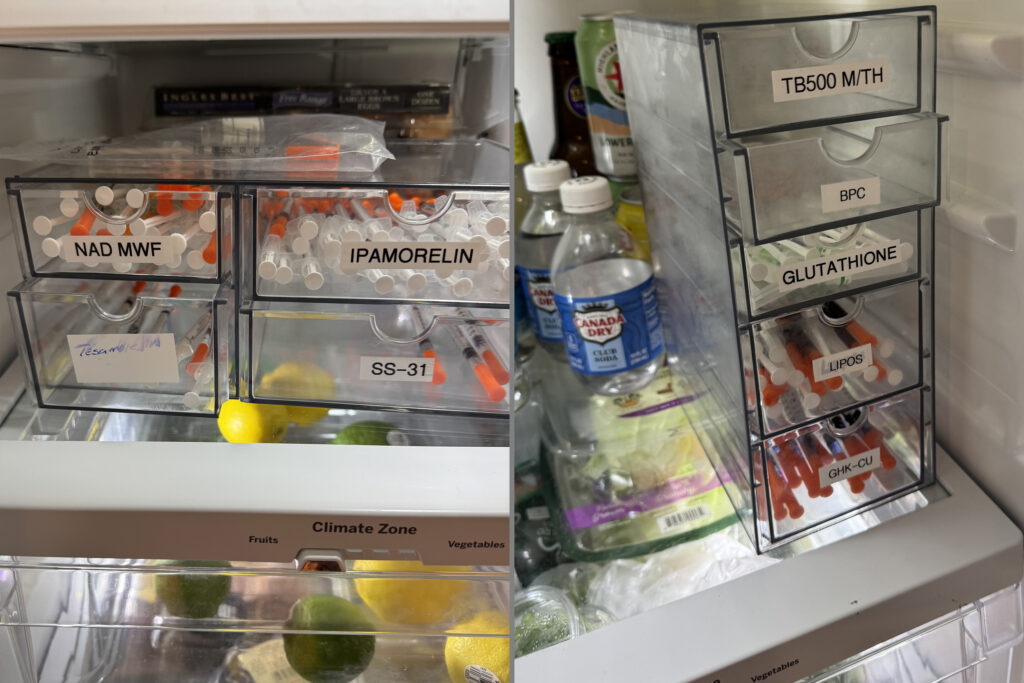
Open Ibrahim’s home refrigerator and the setup looks less like a kitchen and more like a small clinic. Next to a few single-serve bottles of Canada Dry club soda sit clear plastic Crate & Barrel-style organizers packed with preloaded syringes labeled TB500, BPC, GHK-CU and Ipamorelin. Other peptides sit nearby, including several in nasal spray form, all lined up and ready for use.
Peptides first came onto Ibrahim’s radar more than a decade ago, back when Melanotan and PT-141 were still part of the same molecule. People experimenting with Melanotan often reported a strange pairing of side effects: nausea and a sudden spike in libido. PT-141 had a similar payoff. Users described feeling intensely horny, alongside the same queasiness and tanning effects.
One night, Ibrahim was scrolling through an internet forum where people shared their experiences with the compounds. In one post, a man described trying PT-141 with his girlfriend. The peptide hit so hard, he wrote, that the two ducked into the handicap stall of a bathroom. She gripped the metal handrails, looked back over her shoulder and told him, “Don’t stop just because I’m throwing up.” Consider Ibrahim curious.
Today, patients come in multiple times a day asking Ibrahim about peptides. And he prescribes them. But not the same ones William or Daniel are getting dirt cheap from overseas suppliers. The versions he offers cost closer to $400 than $40, and he limits his prescriptions to peptides that come from FDA-certified pharmacies.
The price difference, he explains, is not arbitrary. It comes down to something deceptively simple: structure. A peptide works only if its shape holds. Think of it like a key. If even one ridge is slightly off, the whole thing stops working. Peptides are even more unforgiving. Their bonds are fragile and once that structure starts to break down, so does whatever function they are supposed to perform.
That’s where the real cost comes in. It’s not especially difficult to create a peptide in a ninth-grade chemistry lab. What is difficult is making one that stays stable, sterile and intact inside a vial for weeks. That requires controlled conditions, careful handling and a level of monitoring that cheap manufacturing does not account for. Even minor errors in production can change how peptides behave entirely. Dr. Gary Clayman, chief medical officer at the Hospital for Endocrine Surgery in Tampa, Florida, says at that scale, imperfections aren’t negligible. They can alter the compound itself.
The peptides Ibrahim prescribes come from pharmacies that inspect for sterility, purity and bond-stability. Even if the compounds themselves are not FDA-approved, the environments they are produced in are tightly regulated. There is oversight. There are standards.
The same cannot be said for the peptides young men are buying from sites like Oath Peptides and Certified Pep, or through links passed around in fraternity group chats and TikTok feeds. These products often bypass those safeguards entirely. Sellers may include certificates of analysis or so-called “purity tests,” but those documents are only as credible as their source.
Clayman says the bigger risk isn’t what users think they’re injecting, it’s what they don’t know. A peptide labeled “99% pure” still leaves that 1% unaccounted for. In an unregulated market, that missing percentage isn’t abstract. It’s whatever else is in the vial, going straight into the body.
Many peptides originate from overseas manufacturers, where there is little oversight and few guarantees that what’s on the page reflects what’s actually in the vial. But even peptides from U.S. suppliers, labeled for research use only, aren’t meant for human injection – a warning that the young men turning themselves into lab rats ignore. If you take them, Ibrahim says, you’re not just paying less. You’re gambling on what you’re putting into your body, with risks that can escalate far beyond a wasted dose.
“So now what you got is something being made in China or India,” Ibrahim said. “You don’t know what the f— is in that vial. You have no idea if it’s sterilized. You’re one shot away from meningitis.”
Ibrahim recalls a patient who had to learn the distinction for himself. Growing up, the patient could never afford Air Jordans, and the desire for a pair stuck with him. When an anniversary edition pair dropped, he finally decided to pull the trigger. But as he was checking out, an ad for a cheaper dupe popped up on his screen. They looked identical to the real thing but cost a few hundred less. Close enough, he decided, and bought the duped Jordans instead.
Around the same time, he also ordered peptides from a Chinese supplier; they looked real too.
When the Jordans arrived, the difference was obvious. The box was battered, the shoes were off, cheap and clearly fake. He knew immediately he’d been scammed. Then came the peptides. He unboxed the small glass vials filled with white powder. They looked perfectly real. But there was no branding he trusted, and absolutely no way to verify what was inside.
You can spot fake Jordans in seconds. With peptides labeled “for research use only,” you’re hoping for the best and injecting the unknown. At least with the sneakers, the scam was obvious. With the vials, there was no way to know. He threw the peptides out. Now he pays hundreds more to avoid a far more dangerous knockoff.
Shamus*, a third-year student at an East Coast university, isn’t concerned with what’s “real” and what’s not. If it works, it works. Now 21, he’s a competitive national powerlifter who recently made Team USA for bench. He was 19 when he started injecting, but before that he took oral peptides. After straining his pec while lifting, he went looking for something that could speed up the recovery. Social media and online forums pointed him to peptides. He walked into a local supplement shop, the kind of place that looked sketchy enough to have what he needed. He left with TB-500 and BPC-157, two oral peptides marketed for tissue repair and accelerated healing.
That was the entry point. He started small, then added more compounds to his routine, later building out an injectable stack the same way someone might add new vitamins to their morning routine. But Retatrutide was different. That was the one that hooked him.
At 172 pounds, Shamus looks like a healthy 21-year-old. But when he looks in the mirror, he sees a whale, even if the numbers tell a different story. Since starting Retatrutide, Shamus’s body fat has dropped to 8 percent, down roughly 20 percent from where he began.
Like Shamus, most of the kids call it Reta, a nickname for the investigational peptide that targets the hormonal pathways involved in appetite control and blood sugar regulation. Think off-brand, under-researched Ozempic. Shamus just liked that it silenced the food noise. And that it helped him get shredded. He wanted to be like the guys he saw all over social media – the lean, ripped “looksmaxxers” who gained new followers by the second for their impressive physiques.
“I was doing it to clout chase. Body dysmorphia played a part, but I wanted to get really shredded and then post on social media and get famous, or get external validation,” Shamus said.
Shamus’s TikTok username at one point was @peptideabuser. He posted needles, or certain content that alluded to him using peptides, but never actually outright said he was. It was a game to him, sort of a joke – he wanted to keep people in the fitness community guessing. But he also posted videos of his physique, and those got attention. He was hooked on external validation, constantly refreshing TikTok or Instagram and waiting for the likes to roll in. He describes the process as a form of neuroticism.
The attention did come in, but in the form of a DM. A guy working with Onyx Research peptides reached out to Shamus, offering to send him a few vials to try and to post about. If people used his code to purchase, he would get a 20% commission cut. More if he wanted to be paid in product. It was an easy yes.
Aaron, a 22-year-old student at the University of Colorado Boulder, understands the temptation to enter the peptide business. One of his friends started posting videos similar to Shamus’s, before-and-after clips, physique updates and promotion of the peptide behind the results. His friend launched his own peptide brand and made more than $20,000 in the first month, driven almost entirely by those videos.
But $20,000 is chump change in the growing peptide market. The New York Times reported that imports of hormone and peptide compounds from China doubled to $328 million in the first three quarters of 2025, up from $164 million during the same period in 2024. Now, in 2026, Wall Street analysts believe the market for peptides could exceed $2 billion. The imports span from GLP-1 compounds to Melanotan II, moving through med spas, compounding pharmacies and the same gray-market pipelines Shamus and so many other young men are tapped into. But regulators are starting to notice. U.S. Customs and Border Protection has ramped up inspections, with peptide seizure rates up an estimated 400 percent in 2025 compared with the year before.
Shamus wasn’t just watching that market grow. He was in it. Onyx Research knew Shamus looked the part, and that he was already using peptides. He had 10,000 followers and people were asking what he was taking. All he really had to do was keep posting, and keep feeding the same cycle that got him there in the first place. Unlike Aaron’s friend, Shamus cashed out in product.
The process for the seller and the buyer, Shamus says, is simple. A company like Onyx contacts a manufacturer in China, sends over a label and a design and orders in bulk. For a few thousand dollars, peptides arrive branded and ready to be sold. A sample vial gets tested at Janoshik or another testing lab, a certificate of analysis gets posted and the numbers look clean enough to trust. Then the site goes live and anybody can buy.
On the Onyx site, that ease is immediately apparent. The interface is straightforward, with dozens of peptides to choose from, but selecting something like a 5mg vial of BPC-157 takes only one click. It’s advertised as 99% pure, paired with a disclaimer that it should not be used for human or animal injection and priced at a mere $45. The process is built to feel easy. Shamus says that’s the point. “You’re saying, ‘Oh, buy these,’ and then, in a really quiet voice, you’re like, ‘For research purposes,’” he said.
The warnings may be easy to ignore, but the results are not. Shamus’s childhood best friend watched the changes happen in real time. The weight coming off, fast enough to notice. Fast enough to want. He wanted to look like Shamus, so he ordered some Reta and started taking it himself, maybe more than he should have. Shamus doesn’t see himself as the reason his friend started. In his mind, whatever influence he had is dwarfed by the constant churn of TikTok looksmaxxing videos. Now, Shamus says, it’s been taken too far. His friend is skin and bones, and won’t stop injecting.
What’s concerning isn’t just the amount or the frequency of injection. It’s how normal it becomes. The needle goes from something you hesitate over to something you barely think about. And for a lot of young men, it starts the same way Shamus’s friend did, with someone they trust saying it worked.
Like Shamus, Jayden started on peptides after an injury. The Florida State University senior was looking for anything that might heal his broken leg a bit faster and was pointed toward BPC-157 and TB-500 by a friend.
Clayman doesn’t recommend these peptides for accelerated healing. “What about ice and rest for 72 hours? What about phototherapy, infrared therapy, laser therapy, which has zero risk?” he asks. “What about acoustic wave therapy? What about other things that are not injectable, where you’re not putting foreign materials in your body?”
But Jayden liked the promise of faster healing. At first, he was careful. He kept the vials in the fridge, wiped everything down with alcohol before injecting and paid attention to what he was doing. But that vigilance didn’t last. When he ran out of alcohol swabs, he didn’t replace them. The risk of infection felt theoretical, like something that happened to other people. The same logic extended to the peptides themselves. Nothing had gone wrong so far, and that made it hard to believe anything would.
Ibrahim understands that thought process. Without many widely known cases of negative side effects or visible consequences, it’s easy to categorize peptides as low risk, especially when the people around you seem to be benefiting.
“You haven’t heard of anybody who got hurt, you don’t know anybody who got meningitis,” Ibrahim said. “And your buddies here that are doing it look better than you do, so by God, you’re going to get on the bandwagon and do it.”
Aaron* started on peptides for an entirely different reason than looks. He wasn’t getting good sleep and he was stressed with exams and a heavy academic load. His best friend James* had a few vials of DSIP, a peptide that promises deeper, better sleep. Aaron wanted in, but was too nervous to inject himself. James did it for him. He woke up the next day feeling well rested.
Since that one seemed to work, Aaron decided to add a few more to his routine. The changes were visible. GHK-CU helped clear his eczema, and Melanotan, well, you should see the bronzed skin on this guy.
But what kept him going wasn’t just what he saw in the mirror or felt when he woke up. It was a deeper skepticism about traditional medicine. He had been prescribed Ritalin at 13 for attention deficit disorder and remembers feeling overstimulated, like the solution didn’t match the problem. To him, that experience made medicine feel reactive, like something that stepped in after things had already gone wrong. Peptides offered something that felt different, more self-directed – less about being treated and more about taking control.
“Instead of having anxiety, I can pin my Selank; instead of getting older and having shitty skin, I can take GHK-CU,” Aaron said. “Instead of not being able to focus in class and taking my Ritalin, I can have slept really well and be really alert because I took my sleeping peptide — I kind of saw it as a replacement for a lot of the other things that we’re prescribed.”
Heather Murphy, an advanced practice registered nurse at Tampa General Hospital, understands where Aaron is coming from. Though she hasn’t heard much conversation around peptides in the conventional medicine world. She says they’re all the rage for those who like to take a more functional approach to health and prevention.
“People are just feeling more empowered,” said Murphy. “Rather than waiting until they have a disease to start treating things, they’re working towards optimal health and using these peptides or different supplements to help them get to where they want to be.”
Murphy thinks a lot of consumers are demanding something different from the medical system, and potentially demanding something the medical system isn’t ready to give them, so it’s no shock to her that these young men are going elsewhere to get peptides. Even she has taken part in it — she injects CJC-1295 with Ipramorelin to tone her body, as well as GHK-CU to help her skin and hair. But like Ibrahim, she pays hundreds of dollars and gets them from trustworthy compounding pharmacies.
She worries about what’s in the gray-market peptides that have become the norm for young men. The lack of data, and the suppliers that outsource from overseas, do not leave her feeling confident.
“As a healthcare provider that works in hospitals, it would concern me what those things might do to their body,” said Murphy. “The possibilities are so endless; you have no idea what you’re putting in your body. I wouldn’t want any of these to be contaminated with fentanyl or something super dangerous.”
Murphy fears that gray-market peptides are not as pure as they claim to be. She recommends anybody using peptides, or interested in them, source from compounding pharmacies that are held to a national standard. At least then, you know what you’re getting, for the most part.
But the reality is that there isn’t always a way for these young men to truly know what they are injecting. Peptides themselves may not be inherently harmful, and actually can be beneficial if prescribed and purchased from regulated pharmacies. It’s the way they’re sourced and used by young men that frighten healthcare professionals like Ibrahim, Clayman and Murphy. It’s even started to worry some of the young men taking them as well.
Aaron came home one day to find his best friend, James, starting to inject Melanotan. But the vial looked contaminated — it was clumpy with little blobs of powder floating around in it. James started drawing it out anyway. “What are you doing?” Aaron asked. “I absolutely would not touch that.”
James injected it anyway. He said he knew the peptide still worked because he still felt like “s—.” Like William, Daniel, Shamus, Aaron and James enjoy the tanned skin they get from injecting Melanotan, they also justify their use with the argument that it protects from further UV skin damage.
Clayman finds that argument comical. He says melanocyte-stimulating peptides raise one of the biggest concerns. Melanoma develops from melanocytes, the very cells these compounds are designed to activate. Stimulating them further doesn’t exactly point in the protective direction.
Shamus doesn’t buy the whole “I’m on it to protect my skin,” justification. It’s all for aesthetics, he says. When Shamus was ordering Retatrutide from China, he tossed in Melanotan for an extra ten bucks. Why not, he figured. But he injected a little too much. “I did it wrong, and my protocol was incorrect, and I broke out in like, freckles and moles,” Shamus said. “I was like, ‘I’m gonna die of melanoma.’”
The risks aren’t limited to what a peptide is marketed to do, or even what it actually contains. For some users, the concern shifts to how these compounds might interact with the body’s inherent vulnerabilities.
At 21, Shamus has had multiple tumors removed from his neck, and the possibility of regrowth is always in the back of his mind. BPC-157 and TB-500, two peptides he takes, are associated with angiogenesis, which can cause the type of accelerated growth that, in theory, doesn’t distinguish between muscle, tissue or something more concerning.
It’s not a risk he can track in real time, which makes it harder to ignore. So he tries to be deliberate and careful about when he takes them. They’re the peptides that make up the “wolverine” stack, named for their regenerative properties. He turns to them only when he’s injured, and makes sure not to run them long-term.
He says he’s not worried. It’s become routine to him, just another part of his schedule. It’s become routine for a lot of guys who take peptides.
“It is kind of crazy how quickly it became normalized,” William said. “The same people that three months ago would freak the f— out if they found out I was doing this shit are the same people that are now taking them.”
For young men immersed in peptide culture, resistance is not always simple. Their TikTok feeds are saturated with transformation videos, their Instagram Reels with before-and-afters, and their friends with firsthand testimonials. The gray-market products are cheap, accessible and hard to ignore. Ian Burns, a Syracuse University senior, says that’s exactly what makes them tempting. Every time he opens social media or talks to friends who are using them, he sees the same evidence: results. Still, he knows the science is limited, and he doesn’t believe his health is worth risking for what he calls a quick fix.
William calculates the risk differently. He knows the gray-market peptides he orders could be dangerous, but because he gets them tested for purity, he believes the price difference justifies the risk.
“It’s all directly from China, so it’s very sketchy — I mean, I talk with these dudes via Telegram,” said William. “But if you buy gray-market, you can get a five-year supply of peptides, probably over $6,000 worth, for 200 bucks, so how is that legitimate?”
He does not have an answer to that question, but he trusts the results anyway. Even William, who knows his way around gray-market sourcing, admits that many vendors are likely not testing their peptides properly. One of his fraternity brothers orders them by the case from China, marks them up and resells them through an AI-built website to customers who have no idea what they are actually buying. What’s stopping hundreds of others from doing the exact same thing, William wonders.
Shamus doesn’t see this way of sourcing changing anytime soon. For young men, the barriers for going through legitimate channels feel both logistical and personal. Bringing the subject up to parents is uncomfortable, and the price gap makes the risk feel almost rational.
Murphy thinks the gray market will keep thriving for peptides, with or without FDA approval. And she worries that the medical community still does not know enough about them. As a midwife and APRN, she remembers when it was standard to give patients certain hormones to prevent preterm labor, only to see, a generation later, those same women develop uterine abnormalities. Peptides, she believes, may be in a similar early phase.
Young users aren’t worried about the lack of research because they’re seeing the results they wanted. They haven’t heard of any horror stories, or any downsides, so there’s really no hesitation. “Steroids are like vodka, peptides are like beer,” said Shamus. And who’s ever heard of a college-aged guy being careful with beer?
When peptides are seen so casually, it doesn’t take long for them to feel normal. Shamus thought he would only use peptides to heal his pec. Jayden once wiped down his vials with alcohol swabs. Aaron used to need his friend James to inject him. James is now on testosterone. William once believed he would never inject anything into his body. Now, every so often, he finds an old 31-gauge needle under his bed.
“If I could go back in time, I do wish I never learned about these,” said William. “I do love them, but at the same time, I’m injecting every day. That is not normal.”

is a digital editor for The NewsHouse.