
Why a Syracuse-area nonprofit CEO tried to kill a story about a former Baldwinsville police officer
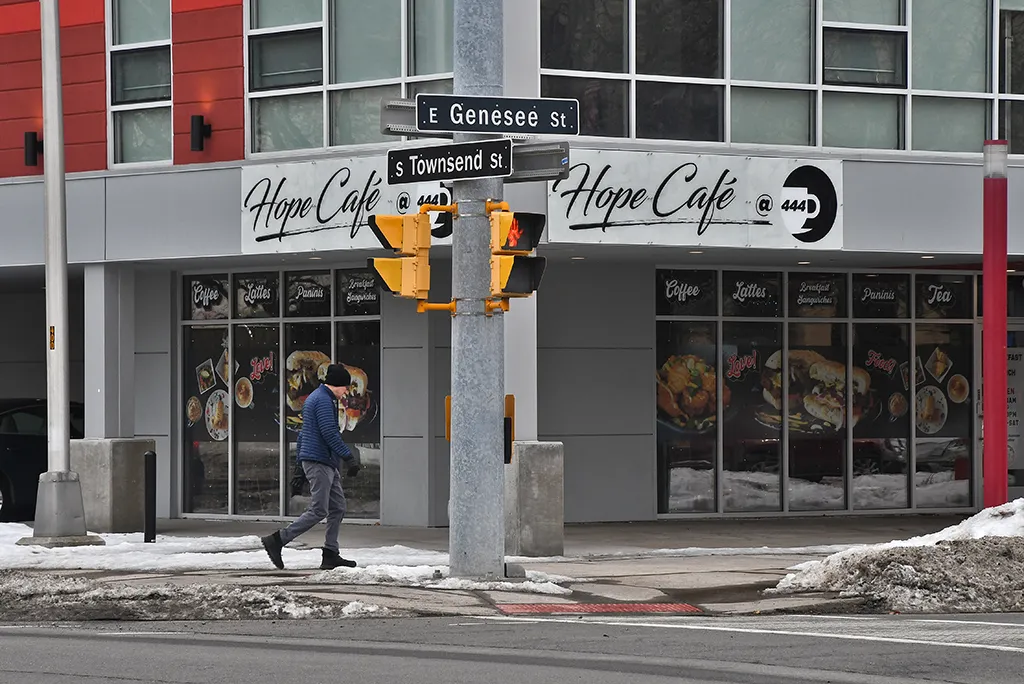
Hope Café CEO Matt Cullipher suggested Central Current may be a good fit for its sponsorship program in the same email he suggested Central Current may make inaccurate accusations against a major donor to his nonprofit.
Hope Café CEO Matt Cullipher suggested Central Current may be a good fit for its sponsorship program in the same email he suggested Central Current may make inaccurate accusations against a major donor to his nonprofit.
A joint investigation between the S.I. Newhouse School of Public Communications, Central Current and USA TODAY Network-New York.
Editor’s note: This story is the second story in a series investigating police disciplinary records across New York State. You can read the first here. USA TODAY Network-New York, Central Current and students from Syracuse University’s S.I. Newhouse School of Public Communications have teamed up to reveal records that remained hidden until 2020, when New York politicians repealed laws hiding police officers’ disciplinary records. USA TODAY Network-New York obtained the records through the Freedom of Information Law.
The chief executive officer of a prominent local nonprofit tried to kill a news story about the misconduct of Tom Czyz, a former Baldwinsville police officer who abused a prisoner in 2005 and the owner of security company Armoured One.
Matt Cullipher, the CEO of Hope Café and The People Project, emailed Central Current requesting a story about Czyz not be published — and floated the possibility of Hope Café financially sponsoring Central Current in the same email.
Armoured One, specifically Czyz, has been Cullipher’s charity’s “number one” donor for a “very long time,” Cullipher wrote in the email.
Czyz’s misconduct as a former Baldwinsville police officer was at the center of a recent Central Current article. The department punished Czyz for being part of a trio of officers who exposed and posed with a prisoner for what department officials wrote was a “demeaning” photograph.
Cullipher incorrectly asserted in his email Central Current had been misled by a disgruntled former employee of Armoured One about Czyz’s misconduct record.
“If it is true that one of Armoured One’s ex-employees is utilizing contacts within your company to write a hit piece against Armoured One or Tom, I would highly suggest against publishing any such story,” Cullipher wrote in the initial email.
Central Current did not receive a tip from any former employees of Armoured One. Reporters discovered Czyz’s case in publicly available disciplinary records from the Baldwinsville Police Department, through a database created by Gannett | USA TODAY Network-New York. Reporters compiled this database after New York lawmakers in 2020 repealed Civil Rights Law 50-a, which made police disciplinary records public.
Reporters repeatedly told Cullipher that the story came from the misconduct documents — not a disgruntled ex-employee. In each interaction with Cullipher, he maintained Central Current was being misled, and the story should not be published if the organization was informed by an ex-employee.
Associate Director of the Cornell Law School First Amendment Clinic Heather Murray called Cullipher’s email “unusual” and an “explicit” attempt to stifle the story.
“He clearly overstepped the line,” Murray said. “I think that it’s important to make that clear.”
The email from Cullipher was the first of several conversations with Central Current reporters — via email, text message and over the phone. Central Current published the story that concerned Cullipher’s request.
Why did Cullipher try to step in?
Czyz and his company, Armoured One, are a vital funding source for Hope Café, Cullipher said during an interview with Central Current reporters. Hope Café and The People Project direct their money toward children in Africa and South America.
“Both Tom Czyz and Armoured One have been an absolute godsend to The People Project and other local charities. They have shown their solidarity with men, women and children who are in need locally and in EXTREME need globally,” Cullipher texted a reporter.
Cullipher found out about Central Current’s story from the front of house manager at Hope Café’s downtown location, he said.
The manager, who Cullipher only identified by his first name, Christian, told Cullipher he overheard a conversation between two patrons, one of them being a disgruntled former employee at Armoured One, Cullipher said.
“The customer mentioned that they were using a contact at Central Current to put out a hit piece against Tom Czyz, the CEO of Armoured One,” Cullipher wrote in the email to Central Current Executive Director Maximilian Eyle.
Cullipher disclosed in the email that English is Christian’s second language and said that Christian could have misinterpreted the interaction. Christian is from Peru, Cullipher told reporters on a later phone call.
After Central Current received Cullipher’s email, reporters called Cullipher to interview him about his requests. During the call, Central Current reporters told Cullipher they discovered the allegation against Czyz in public disciplinary records and clarified that no disgruntled ex-employee tipped off the publication to the story.
Cullipher promised to provide reporters with video footage of the interaction between patrons at Hope Café. He and Central Current reporters initially agreed to a second in-person interview about Hope Café’s and Czyz’s relationship.
But before the meeting could take place, Cullipher messaged reporters to cancel the interview. A lawyer, hired by Czyz, intervened, Cullipher said.
Cullipher texted Czyz after the initial interview to inform him of the plans to meet a second time, Cullipher said. Czyz never responded, Cullipher said.
Instead, Gerry Stack, a partner at Barclay Damon, responded to Cullipher on Czyz’s behalf, Cullipher said. Stack told Cullipher to “cease and desist” from communications with Central Current regarding Armoured One’s “businesses, donations or relationship” with the charity, Cullipher said.
Stack told Cullipher that Czyz and Armoured One are preparing to file a defamation lawsuit against an ex-employee, Cullipher said.
“The attorney told me that the ex-employee had already sent an anonymous email to Armoured One stating that they were using news media to attack Mr. Czyz’s integrity,” Cullipher said.
Stack did not respond to multiple calls from Central Current reporters nor did he respond after reporters visited his office.
After declining to meet with reporters, Cullipher texted them he believed they were “getting played by someone who has a vendetta.”
Cullipher’s long history with Czyz’s family and Armoured One
In recent years, Tom Czyz and Armoured One have become the preeminent donors for Cullipher’s Hope Café and The People Project, Cullipher told Central Current.
Their professional relationship began within the last decade, Cullipher said. In 2017 or 2018 — Cullipher couldn’t remember which of the two years — Armoured One donated a Harley Davidson motorcycle to a Hope Café fundraiser benefiting a teenager with cancer.
The donation, Cullipher said, started a long relationship in which Czyz has become a major Hope Café donor.

“They give tens of thousands of dollars to support our schools in Africa (Kenya and Zambia) each year,” Cullipher wrote in his initial email to Central Current.
Czyz and Cullipher grew up in Baldwinsville and went to the same high school, though they were not friends, Cullipher said.
They reconnected when Czyz came into a now-closed location of Hope Café to pick up food for an event.
Czyz recognized Cullipher and struck up a conversation. Czyz’s father, Randy, was a pastor at a Word of Life Assembly of God Church, a church which Cullipher attended.
Randy Czyz worked at Word of Life Church with late Pastor Brian Heimer, who was a mentor to Cullipher.
“If it wasn’t for the youth pastor in that guy’s church,” Cullipher said, “I don’t think I’d be alive right now.”
When Cullipher began doing missionary work in Peru, he received financial support from the Word of Life Church, which required him to get approval from Randy Czyz.
“You transfer funds through (the church) for projects like this and they make sure that it goes to the project itself,” Cullipher said.
Cullipher said he is unsure if Tom Czyz ever knew the extent of his nonprofit work in Peru.
When the two reconnected at Hope Café, Cullipher told Czyz that Hope Café and The People Project were struggling to find a long-term funding source.
Hope Café was part of the answer to The People Project’s funding questions, Cullipher said. Before he created the café, the nonprofit relied on donations from its board, about 10 yearly fundraisers and money raised from the 30 to 40 speaking engagements Cullipher would do each year, Cullipher said.
Cullipher came to rely on financial support from Czyz and his company, Armoured One.
Armoured One contributes a “huge chunk” of Hope Cafe’s flat donations, Cullipher said. This balances the company’s decreased capacity to fundraise as Cullipher performs at fewer speaking engagements and donations have dwindled.
During Cullipher’s phone call with Central Current reporters, he referred to Czyz as “Tommy” but said the men don’t have a personal relationship.
“I’m not, like, super close to these people, but I’ve met them, and I’ve seen their passion for people in need… maybe they’re all fake hypocrites,” Cullipher said. “I don’t know, but it doesn’t seem like it.”
“I’m not, like, super close to these people, but I’ve met them, and I’ve seen their passion for people in need… maybe they’re all fake hypocrites,” Cullipher said. “I don’t know, but it doesn’t seem like it.”
‘What I wrote speaks for itself’
Murray, the associate director of the Cornell Law School First Amendment Clinic, said it’s not uncommon for potential advertisers or sponsors to believe they have control over editorial content — even if it is made clear they do not.
She characterized Cullipher’s request as one of the more “explicit” quid pro quo requests to direct a news organization’s coverage.
Cullipher sent his email to Central Current Executive Director Maximilian Eyle on Feb. 25. The email “shocked” Eyle because the two have never spoken before.
“I read it a couple times just to make sure I fully understood what was happening,” Eyle said. “My interpretation of it, my reaction was that he was dangling a sponsorship in exchange for our cooperation in ceasing an investigation on a story that we were working on.”
Upon reading the email, Eyle never considered taking Cullipher’s offer for a sponsorship, nor did he feel the need to respond, he said.
Central Current is a nonprofit news organization whose business model aims to be independent and transparent, Eyle said. The organization does not sell advertisements because that source of income would be taxed. Instead, it sells sponsorships, which are not. Sponsoring groups intend to support the mission of the organization.
“Sometimes people who have influence over advertising think that means that they can influence coverage, and maybe don’t realize that it really goes against ethical standards for journalists,” Murray said.
When a reporter told Cullipher the second story was about his seeming attempt to stifle the story about Czyz, he wrote that Central Current was writing false accusations and “flat out lies.”
“What I wrote speaks for itself, and you and I both know that there is no expert claiming otherwise,” Cullipher said. “That’s a blatant falsehood.”
Murray, a press freedoms expert, reviewed and commented on the correspondence for Central Current’s story.
Cullipher declined a second phone call interview for this story. Instead he texted a reporter accusing Central Current of misinterpreting his email to the organization, calling the story being pursued about him “an attack piece” with false accusations. He accused Central Current of pursuing the story about him because he relayed accusations about the organization’s journalistic integrity to Eyle.
“The fact that you all are saying that I did not want you to publish the story is not only a lie, it seems to be a very intentional cover-up of the fact that you knew that what you were doing was unethical,” he wrote.
Central Current has been pursuing a story about Cullipher for about six weeks — since he sent the email to Eyle. Reporters had reached out to Cullipher with the intent of gathering his side of the story and clarifying why he sent the email.
“The most important thing we have is the trust of our readers, our integrity as a newsroom, and ensuring that there is no outside or inappropriate influences on editorial decisions,” Eyle said.
About this Project
This story is part of a series investigating police disciplinary records across New York State. USA TODAY Network-New York, Central Current and students from Syracuse University’s S.I. Newhouse School of Public Communications have teamed up to reveal records that remained hidden through 2020, when New York politicians repealed laws hiding police officers’ disciplinary records. USA TODAY Network-New York obtained the records through the Freedom of Information Law.

is a digital producer for The NewsHouse.

is a contributor for the The NewsHouse and Central Current.

is a contributor for The NewsHouse.