
Micron officially breaks ground on Clay megafab
Micron breaks ground on Clay megafab
Dozens of local, state and national officials gather to tout the chipmaker’s future manufacturing plant in Clay.
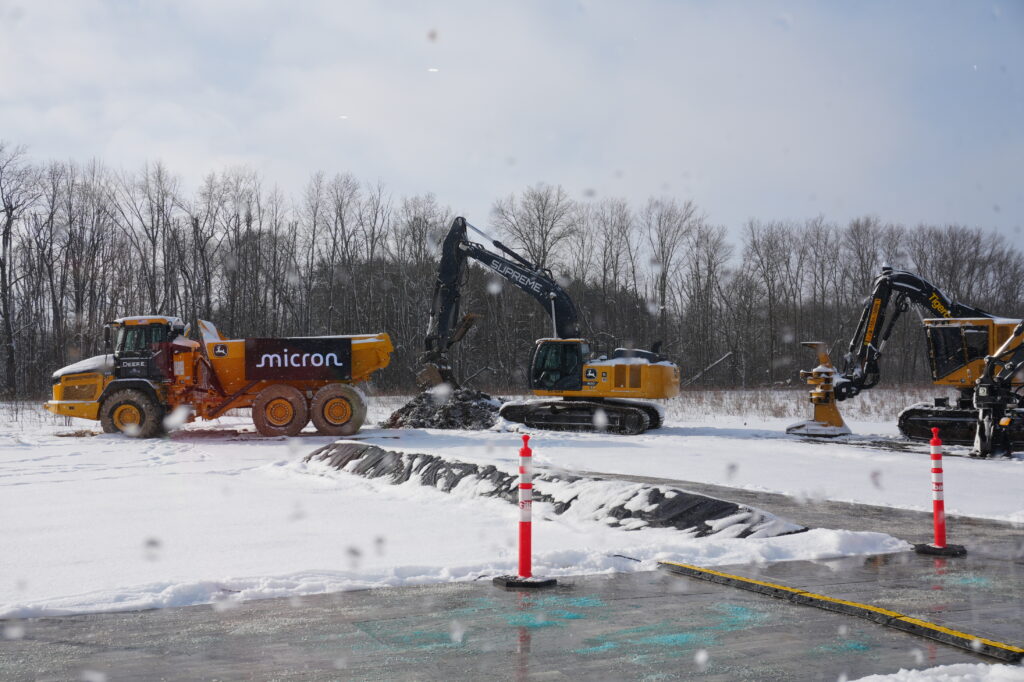
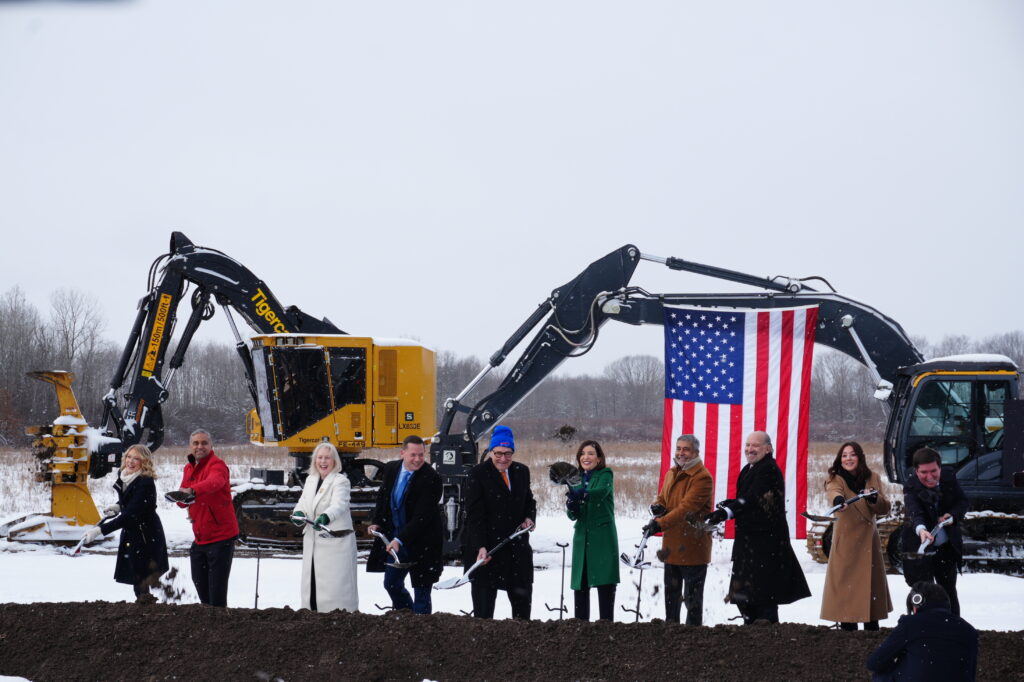
Micron hosted its official groundbreaking Friday morning amid flurries of snow at the site of the company’s first semiconductor facility in Onondaga County.
The breaking was followed by celebratory speeches from officials including Micron CEO Sanjay Mehrotra, Sen. Chuck Schumer, Gov. Kathy Hochul, Onondaga County Executive Ryan McMahon and Secretaries of Commerce and Labor Howard Lutnick and Lori Chavez-DeRemer at a private event in Syracuse University’s Veterans Resource Center.
With construction of the megafab now underway, Clay is officially the future home to the state’s largest private investment.
“[The investment involves] an average contribution of $6.9 billion to New York’s economy,” Mehrotra said.
Mehrotra referred to the facility as the “crown jewel of Micron’s broader American vision” that will enable expansive growth of New York’s economy, job market, and the growth of American leading technological production and advancement and advancement in AI.
“We are here to prove that the United States once again can be the location for the most premier manufacturing on earth,” he said.
The facility will be the second-largest semiconductor facility in the nation, Mehrotra said, and be made up of almost 2.5 million square feet of high-purity manufacturing space with an estimated 9,000 Micron employees working to create 2 million silicon memory chips, or “wafers,” per year.
Another roughly 40,000 indirect jobs will be created as the community remodels, according to Empire State Development.
Initial construction this year will focus on building horizontally, stretching across 40 football fields worth of land. Keeping on track with the four-year plan, vertical building will start next year, according to Mark Plungy, Micron’s director of corporate communications.
Lutnick and Chavez-DeRemer said the Micron facilities in Central New York would enable America to house leading semiconductor facilities, offering competition to South Asian companies, which have dominated the industry.
Lutnick noted that the groundbreaking enables America to profit on AI creation
“We are building the high end of memory,” he said. “The key to the future of AI is right here in America.”
Chavez-DeRemer said the U.S. Department of Labor is expanding partnerships with community colleges, vocational training centers, labour unions and industry groups. They’re also growing apprenticeship opportunities, allowing New York youth to work within the construction, manufacturing, IT and healthcare departments of the facility.
“President Trump’s labor department has been laser-focused on making America skilled again,” Chavez-DeRemer said.
Specified employment opportunities range from scientific professionals specializing in nanoscale processes, engineers, and technicians responsible for maintaining production equipment, according to Mehrotra.

Micron is creating programs to train students in the necessary skillsets to take advantage of the new job opportunities with a “systems change approach,” meaning establishing a set path for current and future students instead of quickly filling jobs.
“We’re looking at the young people,” Rosita Najmi, the Head of Social Impact and Community Engagement for the ED Micron Foundation, said. “The children, the youth, the high schoolers, that by the time the fab is built, will be ready for jobs.”
At Onondaga Community College, (OCC) a cleanroom is dedicated to training students for tech industries. Najmi emphasized there was consideration for environmental impact, too.
“We took our time, we did it right, no steps were skipped or rushed. And so the community should feel really good about that,” Najmi said. This conclusion comes four years after Micron’s announcement in 2022.
According to her, both community stakeholders and the Onondaga Nation were considered in the process.
“One of the things I’m really proud about is how much we have invested in and empower stakeholders from across the community to be a part of the review process. And particularly the Six Nations,” Najmi said.
The predicted increase in laborers residing in Onondaga County will create an additional burden on housing needs, according to New York State Sen. Rachel May. She hopes to bring local housing costs down by increasing apartment complexes near accessible transportation systems.
May’s goal is to focus on where these new communities will be housed.
“Making sure that local communities aren’t just leaning into restricted zoning, because we got to think better about how we build,” she said.
Her concerns echo the general consensus from the day: this is a community project one way or the other.
“Getting this done is not Democratic, it’s not Republican, it’s not Independent,” Schumer said. “It’s America. It’s Syracuse. It’s Orange.”

Digital Producer for The Newshouse

is a digital editor for The Newshouse.