
SUNY-ESF tabling makes science interactive at the New York State Fair
SUNY-ESF tabling makes science interactive at the New York State Fair
Faculty and students bring research to life with engaging exhibits and displays.
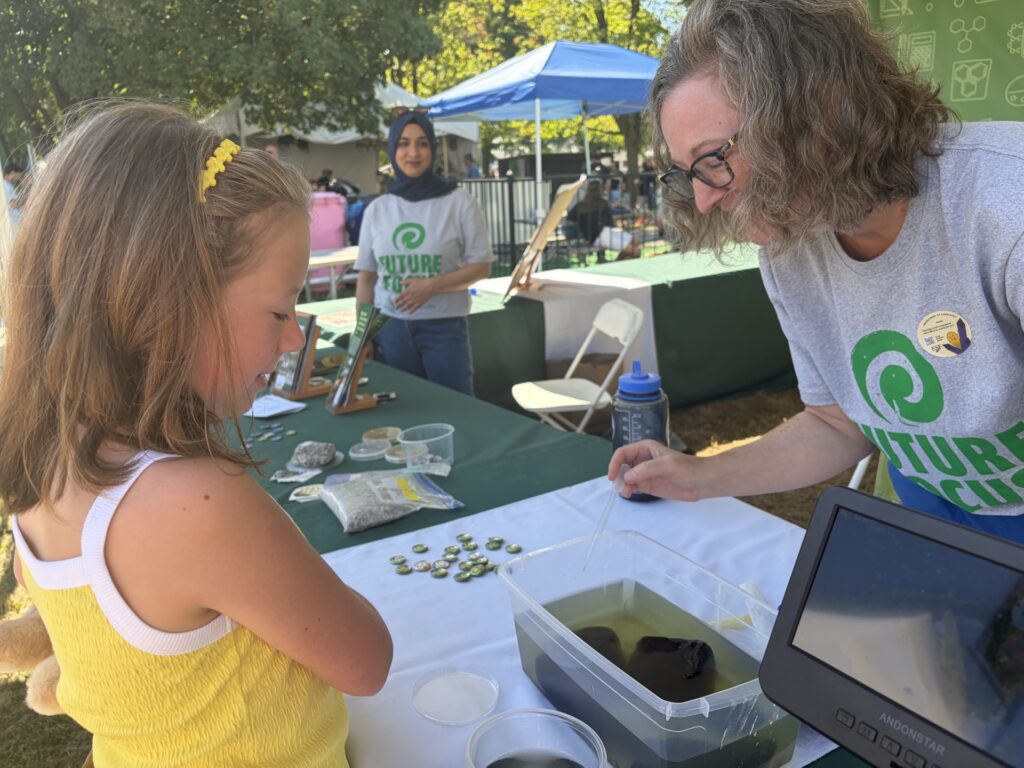
From drawing bacteria shown under a microscope to making seed balls, SUNY College of Environmental Science and Forestry faculty and students tabled an array of interactive displays for fairgoers.
“There’s a big difference between walking by a display that has a bunch of poster boards up and one that actively invites kids over and gets them to play around with things,” Patricia Kapp, an English as a second language teacher in the Utica City School District and fairgoer from Vernon, said.
Kapp said it stood out to her children, Charlie, 6, and Joshua, 10.
“With tables like this, they’ll stay a lot longer. It’s amazing how much they remember about what they learned at the fair once we get home.”
The scientific issues presented were tangible for fairgoers, especially for children.
One demonstration used bowls of water with plastic animals to demonstrate how pollutants, in this case excess products, contaminate the Great Lakes.
“I think it’s so important that they’re learning about their community, their environment, and the things they can do as kids. Even as small as not putting too much soap on their hands.” Marie Darr, a fairgoer from Manlius, said.
For 10 of the 13 days of the fair, ESF manned a table featuring different STEM-related activities, such as examining wildlife specimens collected by the college.
“We see things like the squirrels that we have displayed every single day. But when you get to talk to somebody who studies and works with them, you realize squirrels are a little more special than you think. Even something as simple as their coloring,” Kristen Beyer, 28, a social media manager for ESF, said.
ESF brought a range of specimens from their museum collection, including study skins of squirrels and a golden eagle taxidermy.
“Syracuse has a higher concentration of black squirrels than other areas. So, getting people to realize that their backyard is a bit more interesting than they think is really special,” Beyer said.
The activities are tailored toward young children, but because of their universality, most fairgoers participate in them as well.
“I’ve been out with friends and had people say, ‘I saw you at the fair, and I learned something’. And that’s when you’re like, ‘Okay, this is worth it, this is why we’re here, to let people know that science is important, but we’re also a resource if you have a question,’” Karen Moore, 58, associate director of communications at ESF, said.
Penelope Schwilk, 14, a fairgoer from Geneva, said she admires ESF’s persistence in being an available source for the public.
“I think it’s really cool that ESF goes out of their way to inform people. That must be hard because there’s a lot of ignorant people out there. But it’s nice that they get to teach a new generation about how important nature is.”
Moore said, in terms of results, she’s seen significant public engagement by tabling at the fair.
“Seeing people interacting, getting the information, and asking questions about the college, not just the process but what it’s like at ESF, what kind of vibe it has, and what they can expect, is nice. It’s not just people taking a flyer and going home.”
Federal funding cuts have posed serious obstacles for many STEM programs at universities across the country, particularly in obtaining grants.
Julie Maresca, an associate professor of chemistry at ESF, indicated concern about how it could affect the future of research programs at ESF.
“What has really changed materially for us is the probability of getting funding. It has been a challenge to plan around because we can’t say ‘I’m sure we’ll get money at some point over the next few years.’”
Maresca hosted two activities at the fair, including one on her research in using microbes in concrete to detect early damage before it’s visibly noticeable.
The microbes could become useful tools for managing pollutants or filling cracks in concrete.
Moore said that, in the face of these difficulties, maintaining focus on the innovative projects that scientists like Maresca have been pursuing is incredibly important.
She also said it’s part of the reason ESF continues to table at the fair.
“Despite everything that’s going on around the world, we’re going to keep doing it because there are important issues that science needs to overcome, solve, and bring to light.”

is a contributor for The NewsHouse.