
Syracuse women’s ice hockey finds offensive rhythm without Idalski
With Idalski absent, women’s ice hockey finds rhythm
Orange split series after shutout loss and a four-goal response against Delaware; leave the weekend with a program-best start.
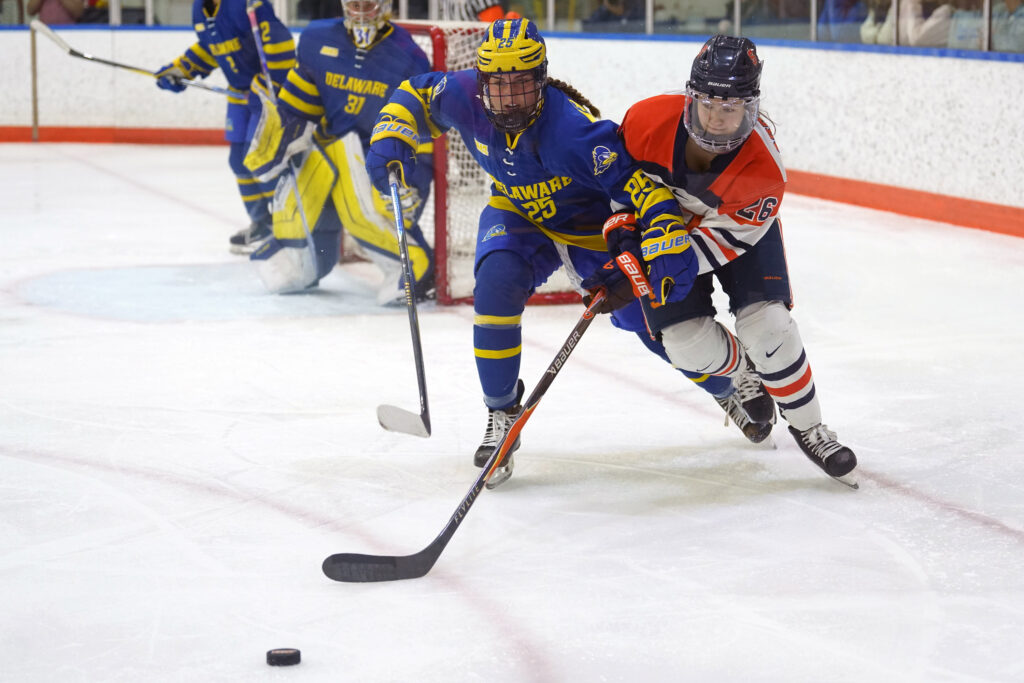
Syracuse women’s hockey employed similar processes but earned vastly different results for their offense in their two-game series against Delaware. The Orange controlled possession and generated chances in Thursday’s 1-0 loss, but struggled to turn that pressure into goals. On Friday, they found more success around the net, scoring four times to earn a series split at Tennity Ice Pavilion.
The weekend also marked associate head coach Brendon Knight leading the team in place of head coach Brian Idalski, who is away coaching Czechia’s national team at the Women’s World Championship. Syracuse maintained its approach despite the change behind the bench and responded to Thursday’s frustration with its most productive offensive performance of the season.
The split leaves the Orange at 7-3-0 overall and 5-3-0 in Atlantic Hockey America play. Their 7-3 start is the best 10-game opening in program history.
Syracuse’s challenge Thursday was not generating opportunities. The Orange outshot Delaware 40-14, including a 26-6 advantage through the first two periods, but could not get a puck past goaltender Charlotte Payne. The Blue Hens needed only one goal, as forward Wren Abboud broke the scoreless tie early in the third period to hand Syracuse its third loss of the season.
Knight said the Orange took too long to establish their rhythm and did not create enough chances in dangerous areas.
“I just thought we didn’t have a ton of chances inside the dots tonight,” Knight said.
That became the focus of Syracuse’s response on Friday. The Orange had plenty of possession and shots in the series opener, but sophomore forward Emma Gnade said the team recognized a need to make more of its opportunities directly in front of the goal.
“We realized we only had four shots in front of the net,” Gnade said. “We knew that she was a goalie that struggled with rebounds and in-front shots, so we just focused on that for this game.”
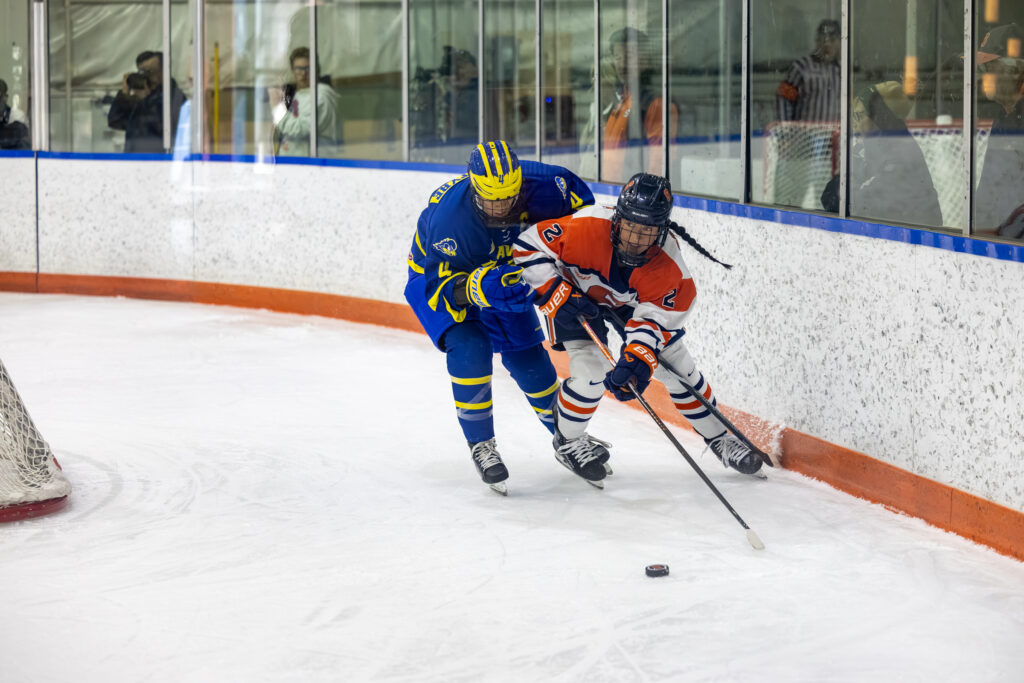
The adjustment showed up in Friday’s 4-1 win. Syracuse again controlled the shot count, finishing with a 44-21 advantage, but its offense was more effective at creating traffic and attacking from close range.
Freshman defender Maryn Broderick helped establish that approach, opening the scoring with a shot from the point through traffic. Gnade and Jackson Kinsler added goals, while Rylee McLeod extended the lead with a wraparound finish. Gnade and Kinsler each finished with a goal and an assist.
The difference was especially apparent in the second period, when Gnade and McLeod scored 50 seconds apart to turn a one-goal advantage into a three-goal cushion. Knight credited the team’s willingness to work the puck down low and create more difficult situations for Payne.
“We really wanted to create some chaos,” Knight said.
Broderick’s contribution also illustrated how Syracuse’s offense benefited from involvement across the lineup. The freshman led all skaters with nine shots Friday, while McLeod recorded seven and Kinsler added six. Rather than relying on one line to generate chances, the Orange received production from their forwards and the blue line.
Sophomore goaltender Ava Drabyk provided another important part of the weekend’s response at the other end. After stopping 13 shots in Thursday’s loss, Drabyk turned aside 20 of 21 attempts Friday. She finished the series with 33 saves on 35 shots, preventing Delaware from building sustained momentum in either game.
Her performance was supported by a defense that limited the Blue Hens to 14 shots Thursday and 21 Friday. Although Delaware scored once in each matchup, Syracuse largely prevented the visitors from matching its sustained offensive pressure.
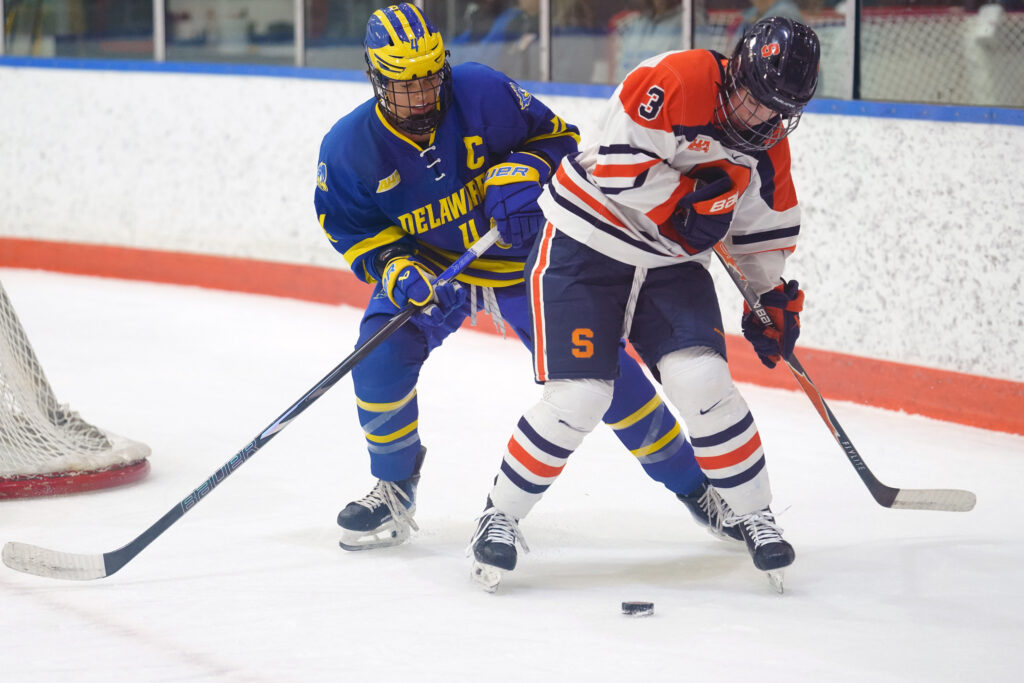
The series also offered a look at how the Orange are handling Idalski’s absence. Knight assumed the lead coaching responsibilities for both games, while the team continued to follow the processes established under its head coach. Gnade said the coaching change did not alter the expectations placed on the players.
“Just because he’s not here doesn’t mean we’re not going to have the same standard,” Gnade said.
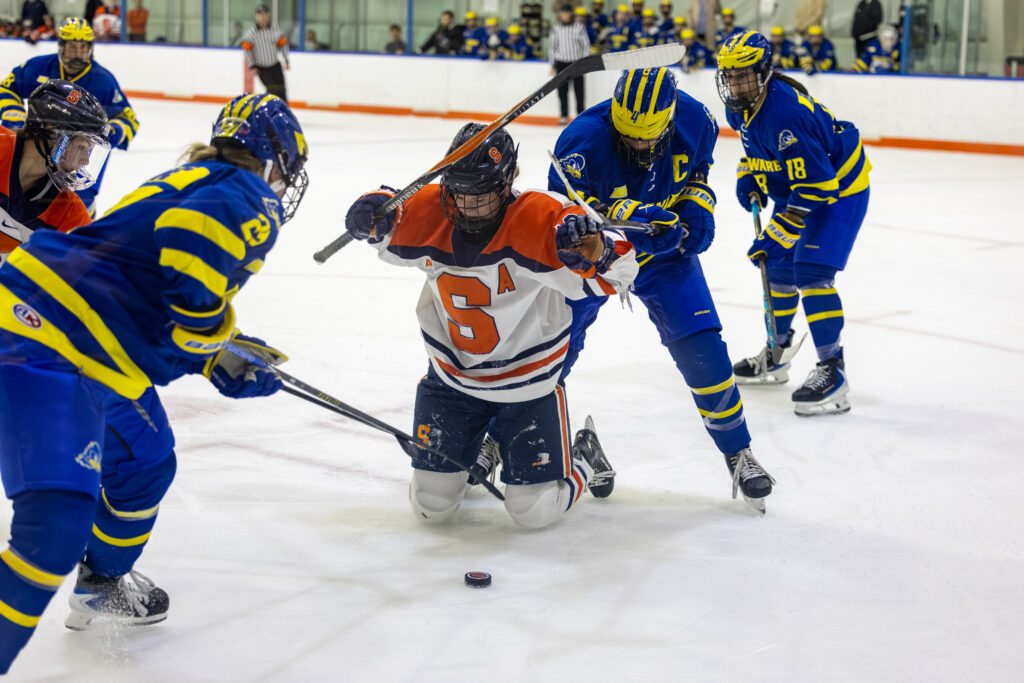
Knight pointed to the team’s increased physical engagement Friday as another sign of its response. After feeling the Orange took time to find their rhythm in the opener, he said the team played with more grit and competitiveness in the second game.
“We’ve got to play gritty,” Knight said. “I just feel as a player when you’re physically engaged, you’re just more into it. It’s more fun.”
Syracuse will look to carry that approach into its next series against Lindenwood on Nov. 6 and 7. The Lions enter the matchup after splitting their most recent series against Robert Morris, following losses in both games against No. 2 Minnesota and a series sweep by Penn State earlier in October. Lindenwood has also split series against Delaware and Merrimack this season.
The Lions’ recent results suggest Syracuse will face a team capable of competing in close games, even after a difficult stretch against ranked opponents. For the Orange, sustaining Friday’s net-front pressure while maintaining the defensive discipline that limited Delaware’s chances will be key on the road.
The weekend against Delaware showed Syracuse can generate offense in different ways, but also that shot volume alone does not guarantee results. With Idalski still away, the Orange will try to build on the adjustments that turned Thursday’s frustration into Friday’s four-goal response.

is a contributor to The NewsHouse.

is a contributor to The NewsHouse.

is a photographer for The NewsHouse.