
I’m an adult woman in modern America. God is calling
I’m an adult woman in modern America. God is calling
Over the last 60 years, progressive congregations have shifted to prefer women with lived experience, rather than the traditional Catholic high school to convent pipeline that dominated the 20th century.
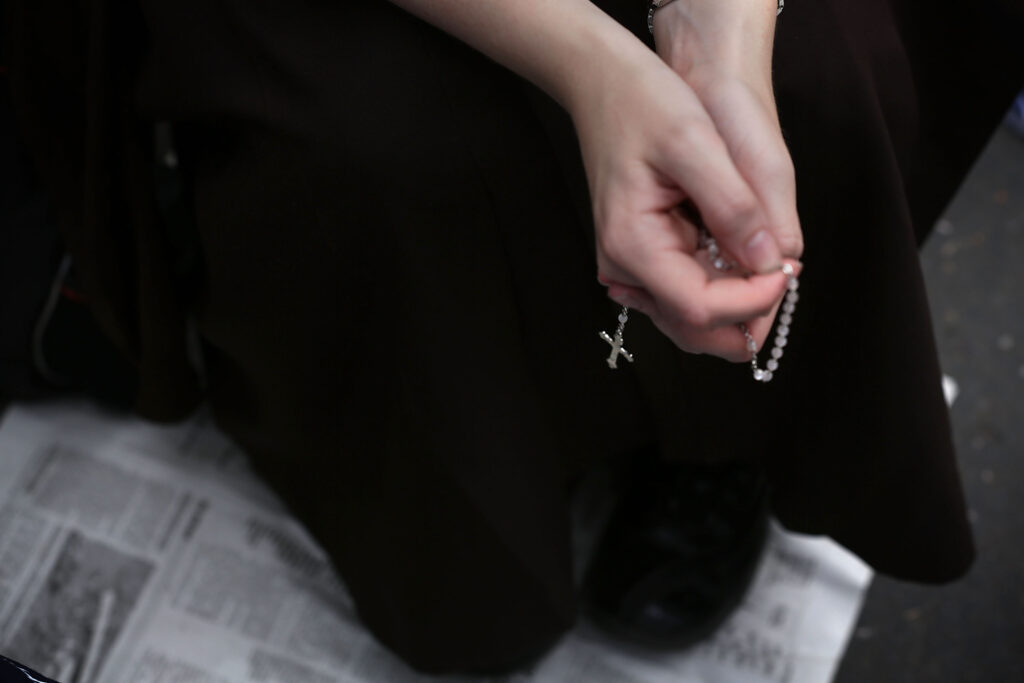
Twenty years ago, Sister Julia Walsh felt two callings. One from God, the other – or others – from several men at once. She’d just started coming to terms with how much she loved the life of sisters, but for the first time, was finally meeting marriage material prospects. She told God that the timing was inconvenient.
It felt unfair to Walsh that God could ask her to miss out on a major part of being human. She wanted the experience of someone being in love with her. But God was calling her to a life that required a completely different kind of commitment.
From 2000 to 2025, around 15,000 fewer people converted to Catholicism per year. A growing number of Americans consider themselves religiously unaffiliated, sorting into Atheists, Agnostics and those who believe in nothing in particular. To practice, let alone lead a religious life, goes against national trends.
Still, God calls. Over the last 60 or so years, progressive congregations emerged under the Roman Catholic Church. Back in 1960, during the “nun boom,” between 6,000 to 7,000 women became sisters every year. As of 2024, the number has dwindled to 100 to 200 each year. While those numbers may seem bleak, some sisters see the decrease as the nun population rightsizing.
Sisters are called to serve much later in life. The path to becoming a nun isn’t as set in stone as it was in the 20th century, when young women who would enter the convent right out of Catholic high school. Today, prospective sisters undergo psychological and physical screenings similar in intensity to FBI entrance requirements. They are encouraged to question their pull to religious life and nurture a religious conscience. The path they choose is a radical departure from the more traditional lives of 21st- century women, but they don’t find their way there without the experiences most 21st century women live through.
Progressive sisters look, speak and act like modern women because they are modern women. Often, they don’t wear the traditional black and white habit and are physically indistinguishable from those outside of religious life. But a force beyond them guides how and why they live.
Sister Bethany Welch, a sister with the Sisters of Saint Joseph of Chestnut Hill, was raised in the Evangelical Fundamentalist Christian tradition. She grew up with the perception that Catholicism was more of a cultural rather than spiritual thing, and that Catholics didn’t always have a personal relationship with Jesus. The measure of faith in the Evangelical community was outward expression. Hands raised in worship. People danced to the spirit of God. You had to physically exert yourself for other members of the church to deem you faithful.
Sister Bethany didn’t explore Catholicism until college, and she didn’t convert fully until she did a year of service in between her master’s degree and the start of her PhD program at a Roman Catholic parish in an under-resourced community in Philadelphia. Over the course of that year, Catholicism became less of an intellectual tradition and more of a lived practice in her life. She often describes her conversion as the feeling of coming home.
In her early 40s, after she’d completed multiple degrees, started a nonprofit organization, published a book and traveled significantly, she still felt there was something more God was inviting her to. She explored the prospect of parenting, became the guardian of a teenage girl and started the application process to foster. But God wasn’t calling her to motherhood.
One-to-one relationships inhibit what Sister Bethany calls radical availability, which translates to the freedom of nuns to give their time completely to the church and its community. The question of “am I going to go pick up my kid from daycare, or can I be available to stay with this person who’s suffering” is answered by their calling, or vocation, to nunhood.
In Sister Bethany’s community, out of around 500 sisters, only six are under 50. Most are in their 80s. The teenage girl she’d been the guardian of now works as a nurse for the older nuns. On January 30th, when Sister Bethany renewed her vows for the second time, she asked to do them at her community’s nursing home instead of the chapel. “I do feel that God is still calling women to this life, and in order to bear witness to that, I wanted these women who lived this already, to be able to see that,” she said.
The vows of religious life are often talked about in terms of what you give up. The possibility of motherhood, marriage, sex and wealth vanish from a sister’s trajectory, which, in the plainest of terms, include poverty and chastity. To people outside of these communities, it can feel like those who choose to serve God are giving up their freedom because they are forbidden from romance and an upwards career trajectory.
Life isn’t binary. Progressive sisters enter the convent out of their own volition. They apply freely, and are intensely evaluated to ensure that their calling is one of spiritual will, not by force from some third-party or an escape from a traumatic situation or other unsuitable environment. The process to get to final vows, called formation, after which a woman is canonically bound to the Roman Catholic Church, takes nine to 12 years on average.
Progressive convents don’t allow women who try and make a split second decision into their communities. The barrier for entry is extremely high. Sister Julia, who serves as Formation Director of the Franciscan Sisters of Perpetual Adoration, frequently rejects applicants. In her congregation, the application process is extensive. There are preliminary identification forms, then a 15 to 20 page “autobiography.” There are separate spiritual and behavioral assessments. They meet with a psychologist, a social worker and a spiritual director, who screen for things like mental health challenges and sexual disorders – such as pedophilia and nymphomania – and then produce a report together. Full physical screenings take place, even dental. Home visits and interviews with roommates occur, and background checks.
But before a prospective sister even gets to do any of that, they must be invited to apply. Sister Julia usually receives a message from someone saying they’re interested in the congregation. Then she typically meets with them in-person or over a video call a few times before deciding whether to invite the interested party to come visit and stay with her community for a while, after which, active sisters leave her comments about whether the visitor should or should not advance into an applicant.
Sister Audra Turnbull underwent a similar process. Her upbringing in Catholicism was more conservative than the congregation she’s in now – the Immaculate Heart of Mary (IHM) in Monroe, Michigan. Her mom was Catholic and her dad was Baptist but they weren’t religious in an outstanding way. She became a self-described “church nerd” on her own.
Sister Audra attended Quincy University in Illinois, a small school where most of her professors were retired Franciscan Friars. College was the first time she gained a deep understanding of social justice. Raised in a small rural town in Monroe City, Missouri, she was fairly conservative and black and white about Catholicism. “They were really the ones that showed me there’s a lot of gray, and that’s really kind of the beauty of things,” she said.
She googled “nuns” one night in college. Then she found a ministry founded by IHM sisters. Ten years later, at 35, she took her final vows.
The decade in between Sister Audra’s first Google search and that last step of formation developed her relationship with God significantly. She had to question her calling and purpose in joining the IHM sisters. She had to question her faith.
Despite the fact that the IHM mother house sits on Elm Avenue in Monroe, Michigan, and Sister Audra grew up on Elm Street in Monroe City, Missouri, she isn’t one to see signs. That’s like wishful thinking to her, or trying to put God in a box. Her walkway to life as a nun was pebbled with small meaningful moments. Every time IHM sisters invited her into their community, she knew she wanted to say yes.
“For me, it’s those silent moments, that heart feeling like, ‘I know this is the right thing to do,’” said Sister Audra. “But I didn’t hear anything. I didn’t hear from God. It wasn’t like a light shining down on me or anything like that. It was to the core of my being; there was this feeling that this is the right thing to do.”
Sister Audra entered formation when she was 25. Sister Julia at 24. Sister Bethany at 45. They had always been religious and in conversation with God, but they’d known the life of the average modern American woman, who dates and crushes and falls in love and is allowed the freedom of sexual exploration. Their calling was so powerful they gave that up.
“Who I am is a person who falls in love easily, who is attracted to people,” Sister Julia said. “That’s always going to be part of who I am, but more deeply, I just desire to give my whole self to God. My body, my will, I wanted to just stick with it for the long haul.”
Sister Julia’s formation took nine and a half years. It wasn’t until the end, when she applied for final vows, that she made peace with both sides of herself: the romantic and the devout.
Sister Bethany made the decision to apply for candidacy after a 15- year on-and-off relationship. “Often, people talk about the vows in terms of negative, right? Like, you can’t have sexual intercourse. For me, it’s a freedom for, not a freedom from. So it’s not ‘I can’t have sex.,’ It’s like, ‘I can be available in a wide range of ways for a lot of different people in my life,” she said.
She felt a vocation to the communities she served in, which were mostly under resourced urban neighborhoods, but also a fear that her romantic partner would prefer she devoted more hours to their relationship instead.
“I went through times where I tried to have a partner feel the same calling that I felt or I’d think ‘why don’t you feel the same call to the same thing I do,’” she said. “And then through that tension, recognizing this is God’s invitation to me. Their choice needs to be their choice, but I needed to be free.”
For those who live without a daily or even weekly dose of Catholicism, the main perceptions they have of nuns might be depictions in popular media. Sisters star in horror plots like “The Nun” or “The Exorcist III.” They act on lust, like in “The Little Hours,” where Alison Brie and Dave Franco’s characters first have sex with each other, and then a threesome with Kate Micucci’s character, too. Most notably, they always wear a habit.
“Even now, if there’s a generic story about sisters in the news, it’s illustrated by a woman or several women in long habits, whether it’s a photograph or a drawing,” said Professor Margaret Susan Thompson, a history professor at Syracuse University,
There isn’t a precise moment in history that explains why nuns wear habits. In the third century, nuns had to wear veils, which were required of all married women. Back then, it was common to embrace a “brides of Christ” narrative, which was eventually rejected by progressive sisters but embraced in more conservative communities. By the fifth century, nuns and monks wore black as a symbol of mourning and sobriety. To become a nun, women have to embrace modesty, which doesn’t involve stylish clothing.
In the early 1960s, the Vatican II council loosened its guidelines for nun dress. Communities were given the option to either redesign the habit, or come out of it entirely. Many progressive groups chose the latter. Sister Jane Aseltyne, also an IHM sister, attributes part of her community’s decision to leave the habit behind to function. The multi-piece outfit they wore was made out of a kind of wool called serge. For sisters who ministered in hot places, it was a complicated, uncomfortable and sometimes unhygienic garment.
Sister Jane never wanted to be in a community that wore habits. She doesn’t like when women are only discussed by their clothes. Some progressive sisters do. Much like they’re called to God, they’re called to dress in a way that makes them distinct from women outside of religious life. The stark black and white of the habit does just that.
In her nearly 40 years studying nuns, Professor Thompson is most surprised by the women who choose to discern in the 21st century. “The first thing you discover in talking to them is that they’re not weird. Not at all. If you met them in your classes or if you met them at a party, you would find them to be interesting and not all that different from yourself,” she said.
Even though they give their life to God, nuns still seek the same things as most people do. They still feel a human instinct for love and intimacy. Both are layered. They’re not restricted to romantic feelings or connections, but when you think about the sheer absence of romance from the lives of sisters, love suddenly seems one- dimensional.
The vow of celibacy and chastity creates a sense of intrigue around the emotional and sexual lives of the religious. Searching “nun” on PornHub returns more than 2,000 hits. “I think it speaks to our society’s obsession with sex and the mysterious. People talking about a vow of celibacy is not commonplace. If you put a pornstar in a habit, there’s going to be the whole mystery, religious kink kind of thing,” said Sister Jane.
The fetishization of a group sworn to a vow of celibacy is ironic. It also ignores the complex psychosexual relationships sisters have with themselves, and the depth of their bonds with each other. In the decades since Vatican II, formation programs have opened up to the idea of sisters dating, or even being married before they discern. It’s no longer a requirement to enter religious life as a virgin. Or to pretend that it isn’t normal to experience attraction, or even fall in love. Those feelings stay, even when you can’t act on them.
When she finds herself with a crush, Sister Kathryn Press, an Apostle of the Sacred Heart of Jesus, knows she’s struggling with loneliness. She thinks, “What else in my life is not being tended to?” In that moment, she considers the strength of her friendships or her relationship to her community.
Sister Kathryn wears a habit. Sisters in her community are called apostles because they have a specific missionary focus. She currently lives in Waterford, Ireland, where the Apostles of the Sacred Heart of Jesus established a mission in 2016 at the invitation of Waterford’s bishop. Ever since she was 10, she’s thought of being a nun.
In high school, when she wanted to be a sister, it was to run away from something. She was 17 years old. She was awkward, and boys were annoying. Nine years later, at 26, she went through what would be her last breakup. That relationship taught her truths about herself. She loved kids and could see herself being a mom. But she did not want to be married.
The breakup did not feel inevitable, but she and her boyfriend at the time were both discerning what God wanted from them individually, and collectively. After they separated for good, she looked back through her life at what had called her since childhood. She didn’t want to wonder what if.
Sister Kathryn knew about the Apostles of the Sacred Heart of Jesus. She lived in St. Louis, Missouri, at the time, where they had a convent. She thought their website was ugly. She didn’t know what their name meant. But they seemed nice. She made her first vows in 2012 and her final vows six years later. “What I said yes to, that I would give my life over to God through these vows, with these women, seems right. Not easy, don’t assume that,” she said.
When she passes to an afterlife or to nothing at all, Sister Kathryn won’t have any next kin. No one will be her widow. And her whole heart can say, without reserve, that this life is what she wants. But as with anything, there are times when you think about what else you would have liked to have.
That part of yourself, the one that most people feel, that makes us do crazy things out of romantic desire, doesn’t go away the moment a woman starts to discern. It doesn’t go away nine to 12 years later, when she takes final vows. It never goes away. That’s part of who we are. A vow to serve the Roman Catholic Church doesn’t strip what makes nuns human.
Being part of a community is intimate in its own way. Sister Jane is completing her PhD in Systematic Theology at Loyola University in Chicago. She lives with five other sisters. They pray together four times a week: three morning prayers and one during the evening.
In her late twenties, she realized she wanted to be part of something bigger than herself. She saw, when she walked into the convent where her great aunts lived, how sisters were showing up for each other and for causes they cared about. They were in community with the world around them. She remembers feeling “there’s something here that I want to pursue.”
She was always the kid wearing a “What Would Jesus Do” bracelet growing up. When she told her friends from high school that she wanted to become a nun, they weren’t surprised. Maybe they thought it was weird, but they weren’t surprised. Some of Sister Jane’s other friends’ only perception of nuns was from “Sister Act,” in which Whoopi Goldberg is hidden in a convent under a witness protection program. They thought she might be joining a cult.
In the years since, she’s continued to invite them into her community, and they continue to show up. A lot of her friends are married or living happily single. Sometimes Sister Jane misses plans for nun meetings. Other times she can be there, at the drop of a hat, because she’s free from a spouse or kids.
Sister Jane wears dark nail polish. She’s in the first year of a five- year PhD program. She’s an out, queer woman studying systematic queer theology. It took her 10 years to feel certain that she wanted to say her final vows and commit to nunhood for life. On the day of the ceremony, when she stood at the altar in front of her friends and family and bound herself to the Church by signing the document of perpetual profession, the first word that came to her mind was “disbelief.”
She is like the other women who are called to serve well into adulthood. Women who are driven by a force of God so powerful it compels them to give up what feels inherently human in order to see their callings through. Who chose the Church because it offers them the freedom to live how they wish, even though the opposite may be our assumption from the outside.
In an alternate world, maybe Sister Kathryn or Sister Jane or Sister Bethany would have stood on the same altar where they professed final vows and instead been part of a ceremony that bound them to a life partner. In a world in which God’s hand never guided them to nunhood, maybe they would be mothers. Maybe they would have rejected society’s expectations and lived independent of romance and parenthood by their own choice. Maybe they would have stayed with the partners they had and always wondered why something didn’t feel right. Or maybe it was always meant to be this way, in any alternate consideration, because God permeates. God is with them all the time and everywhere they go, and they would have always found a way to this path, and their calling.

is a digital editor for The NewsHouse.