
Inside SENSES, Syracuse University’s “Beat Lab”
Inside SENSES, Syracuse University’s “Beat Lab”
New college students need spaces to find community. At SENSES, community is the priority.
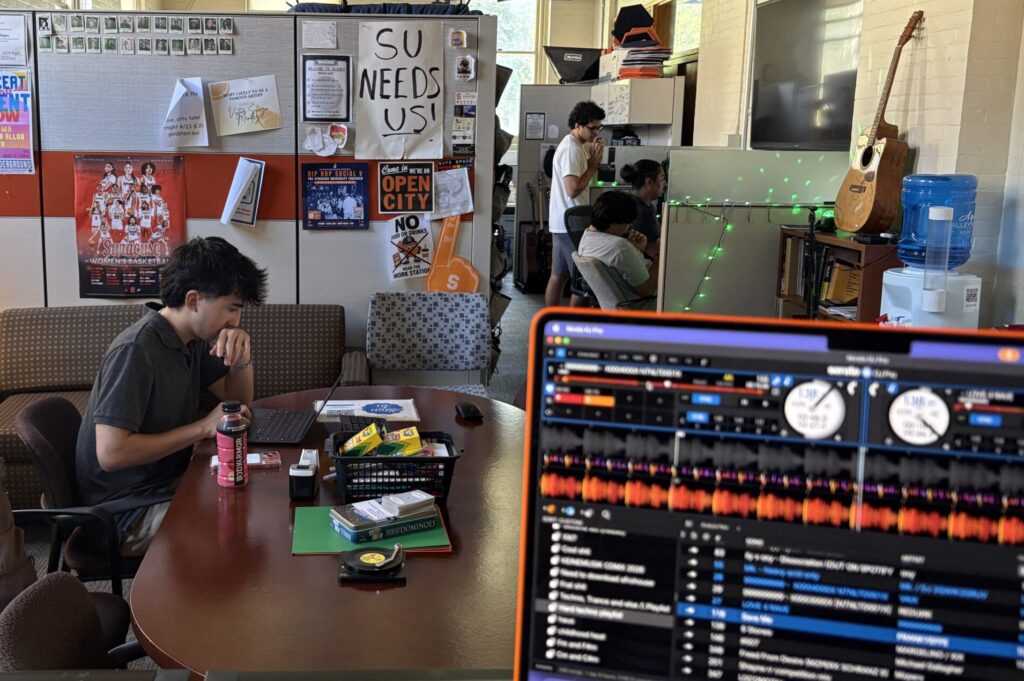
Uzzekiah Harvey first walked into SENSES (Studying an Environment that Nurtures Self-Exploration in Students) the summer before his freshman year at Syracuse University. A bus brought him and other Higher Education Opportunity Program (HEOP) students from New York City to SU’s campus where the group visited the Steele Hall lab and learned about making hip-hop rap beats.
The experience stuck with Harvey and when he returned to SU for his freshman year, he quickly returned to the multimedia lab created to provide equipment and education around music production.
Harvey had previously recorded and written music before college, but without much instruction. He relied heavily on YouTube royalty-free melodies other artists had published to vocalize over, but didn’t have the skills to create music on his own.
SENSES project coordinator Maximiliano Jimenez helped Harvey learn Logic Pro, a professional music software. He began to make beats from scratch while learning to engineer his own vocals. Since then, the second-year student has released an album and helps other students learn the craft.
He said making music attracted him to Steele Hall, but the community kept him coming back.
“When people first go to college, it’s hard for them to find their group because sometimes they feel left out,” Harvey said. “Sometimes they feel like they don’t belong, they feel isolated. But SENSES just made me comfortable. I could be myself when I’m there.”
At Syracuse, SENSES gives students access to industry standard creative equipment and hands-on learning without requiring prior experience or a major in music. The lab holds DJ, podcasting, videography and photography equipment as a way to form a community outside of a classroom, particularly targeting first-generation and HEOP students.
But five years after its launch, growing participation is putting pressure on the availability that made the lab special, as five computers and limited DJ and recording equipment restrict how many students can use the space at once.
“Now the students that this space was created for start to become marginalized in their own home base,” Jimenez said.
Finding community can be a challenge for first-generation students on a college campus. A 2026 Higher Learning Lab research project found that first-generation students reported a significantly lower sense of belonging than other students. It also found that programs created to foster a sense of belonging, including peer mentoring, student organizations and structured cohort experiences can improve first-generation students’ success.
HEOP associate director Amy Messersmith brought the idea of SENSES to SU in December 2020, after attending a webinar about a Texas State University program that used music production with Upward Bound, a federally funded program that helps low-income and first-generation high school students.
Messersmith pitched the idea to faculty members who then collaborated on a proposal for a Cuse Grant, which gives funding to support faculty research and scholarly projects. They received $23,900 through the grant and the funding led to the launch seven months later, Messersmith said.
“I wanted to give [students] a space where they could express themselves and a space where they felt safe enough to connect with other students,” Messersmith said.
Five years later, participation is open to Syracuse and SUNY ESF regardless of major or experience in the musical fields. Jimenez said that access is the mission behind the lab, not necessarily the finished product.
“We are not product based; we are process based … we want you to learn. We want you to experience it. We want you to collaborate with the people who exist in this space,” Jimenez said.
The project also strives to remove financial barriers. Jimenez estimated music equipment can cost hundreds or even thousands of dollars. SENSES provides students with creative tools without requiring them to study music.
The community built at SENSES led to its registration as a Recognized Student Organization (RSO) in 2022. As a RSO, SENSES can recessive student funding and can host events and activities under university guidelines. Jimenez said the project has yet to utilize funding in his time with the program and he plans to get creative with it this year, petitioning for more equipment. But his biggest concern is finding enough room to accommodate everyone who takes advantage of the lab.
“This is a cool space, but if everyone knows about it, then rarely anybody can use it,” Jimenez said.
But determining if a recording studio actually improves belonging is more complex than counting songs.
Jimenez said SENSES is working with the university to evaluate the program’s impact, using qualitative work and a student survey. Results have not been published, leaving the program without publicly available data to see its effectiveness.
For now, the evidence of the program’s impact comes from students themselves.
Isaiah Moses, a fourth-year student studying computer science, is one of those students. Searching for his place in SU’s music scene, Moses found himself at the doors of the SENSES lab. He peered into a crowded room but was nervous to enter.
Eventually, he made his way in and found students making music, sharing their work and learning from one another. Moses kept returning, creating songs and became increasingly involved within SENSES.
Moses and Harvey’s experiences show what a sense of belonging can look like. What started with learning how to make music turned into a “home away from home,” they both said. Moses now leads SENSES as the president and Harvey spent so much time in the lab that Jimenez eventually hired him as a student worker, something he rarely does for undergraduates.
Now Moses, a first-generation senior, is the president of SENSES.
“I ended up just walking in and then realizing, this is somewhere I can belong,” Moses said.
is a contributor to The NewsHouse.