
Black Citizen’s Brigade builds a place for history, art and conversation
Black Citizens Brigade is a place for history, art and conversation
More than a vintage clothing store, Cjala Surratt has a carefully curated collection of artifacts that tell meaningful stories center on Black history.
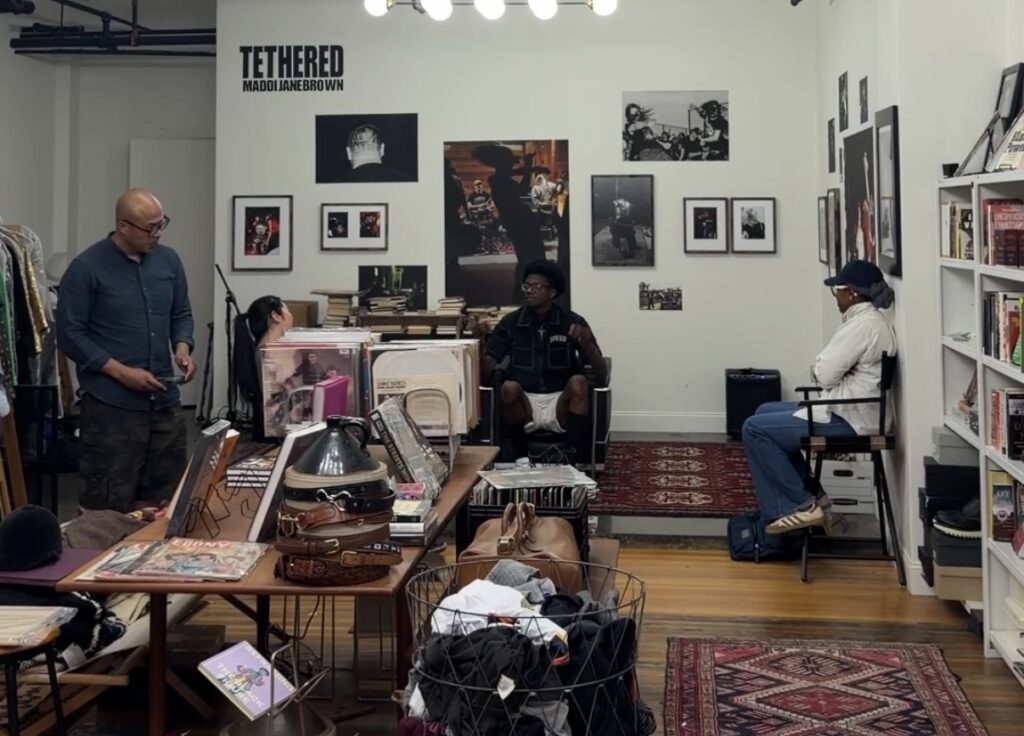
Vintage dresses hang along the racks at Black Citizens Brigade, tucked beside shelves of books, records and other pieces of Black history and culture. A gold “1936” displayed at the store’s entrance references the first year of publication of the Negro Motorist Green Book, the guide that helped Black travelers identify businesses and places where they could safely travel during segregation. For the owner, Cjala Surratt, the reference connects Black Citizens Brigade to a longer history of Black entrepreneurship and opportunity in spaces where Black Americans were often excluded. A first-edition collection of Langston Hughes’ poetry sits on a shelf; the book is signed by Hughes and dedicated to a woman who helped establish the Coretta Scott King Literary Award. The book is not for sale, but Surratt leaves it on display for customers to see anyway. “I like for people to be able to see it and touch it,” Surratt said. “Because I think so often those things that are very much touchstones of our history and culture are inaccessible to us. And I think that should be remedied.” Surratt is a Syracuse native and owner of Black Citizens Brigade in downtown Syracuse. She wears many hats, including mother, community advocate, arts and culture professional and entrepreneur. “I say that I’m an archivist, I’m a preservationist, but I’m also evidence,” she said. Surratt spent almost 20 years in marketing and public relations within Syracuse’s arts and culture sector across a number of organizations including Light Work Photography and Redhouse Arts Center, before briefly moving to Chicago in 2011 and then returning home to Syracuse in 2014. During the pandemic, Surratt began collecting vintage clothing with her daughters. Thrift stores were among the few places they could still visit, and collecting became a way to spend time with her teenage children. “It was a way to get them to talk to me, because they were teenagers,” Surratt said. “There was a passion there that we found together.” Eventually, the collection outgrew the family’s space. A conversation with someone working for a real estate company, Washington Street Partners, led Surratt down an alley where she found an unfinished storefront with a garbage chute, no front door and furniture being stored inside. She saw an opportunity. Black Citizens Brigade opened in June 2023 with about 600 square feet of vintage clothing and expanded as customers expressed interest in more space and programming. Today, the store’s vintage clothing spans the 1950s through the 1980s. Its books, records and collectables center Black history, culture, movements and underrepresented communities. Surratt uses those objects for more than their practical purpose. “I (also) leverage them for prompts around those conversations of race, culture and gender,” she said. Surratt called the Brigade a “third space,” where customers do more than shop. “A lot of what dictates what is in here, and what happens in here, is from the conversations that people bring into the store,” she said. “[Today] we’re very much in a conversation about gentrification here, urban renewal, and arts and culture, and basically whatever people bring in, we talk about.” Those conversations have become part of the store’s identity. Norrell Edwards, an assistant professor of English at Le Moyne College who studies Black diaspora literature, first encountered Surratt at a Syracuse Stage event. She later helped moderate a Short Story Sunday discussion on Haitian writer Edwidge Danticat at the Brigade. Edwards said what makes the space distinctive is how the parts work together. “I think everything does work as an ecosystem,” Edwards said. She pointed to Surratt’s combination of hosting events inside the Brigade and taking the store into the broader community through tabling at local events. “She provides a space, but then also partakes in other community events … that encourages people to get more engaged.” For Surratt, the people who walk through the door are part of the education, too. She said older Black customers sometimes recognize clothing or books from their childhood and share stories that help her put the objects into context. She sees that exchange as part of her responsibility to preserve history. “We’re in a landscape right now where people are actively trying to erase these histories,” Surratt said. “So I think that’s what also keeps me going, is that it’s infinitely important for us to remember.” That same commitment to community eventually shaped Surratt’s decision to run for Syracuse Common Council at-large in January 2026. She described the campaign as an extension of both the work she had already been doing through the Brigade and her years of public advocacy. “Having the privilege to be in here and hear from so many individuals about what their concerns are, their challenges are, their frustrations,” she said. “That’s what led me to it.” Surratt lost the Democratic primary in June and later withdrew from consideration for the Working Families Party line, but said the campaign gave her an unexpected opportunity to hear, in specific terms, how her work affected people. Her husband, Emad Rahim, has watched that commitment to community develop over years. “There’s so much work that goes into advocacy,” Rahim said. “There’s lobbying, education, research, pulling together people with different personalities and agendas into the same room — and she does a great job at that. She’s an educator.” Surratt expected the endorsements requested during her campaign to be fairly general, but was surprised by how much care people put into describing the ways she had impacted their lives. “So often people do not get their flowers until they’re dead,” Surratt said. “And I was astounded by knowing that I had walked gently on this earth and I actually had been of benefit to people.”

is a contributor to The NewsHouse.