
Inside Rochester university’s decertification of 7 police officers
Inside Rochester university’s decertification of 7 police officers
Seven University of Rochester law enforcement officers were decertified in recent years. NY rules allow some to return to law enforcement roles.
A joint investigation between the S.I. Newhouse School of Public Communications, Central Current and USA TODAY Network-New York.
While applying to work in 2024 as a peace officer for New York State in Rochester, Tristan Tennity was honest. He admitted being removed from a previous job during a probationary period, a mistake that came in his early 20s as he began a career in law enforcement.
That issue resulted in his decertification, a process meant to keep law enforcement personnel who run afoul of internal policies or state law from working as full-blown police officers in the future.
Still, he was hired into a new job because he re-did his training and regained his license — but only as a peace officer, which carries a lower level of training and authority across New York.
Six other peace officers from the University of Rochester were decertified after removal for cause, reported to the state under officer rules that classify qualifying separations as “incompetence or misconduct” under sections of 9 NYCRR Part 6056, according to letters sent by the New York Division of Criminal Justice Services. The seventh — Tennity in 2021 — was removed during a probationary period and reported under the same regulatory standard.
Our reporting is partly based on DCJS open-records response spreadsheets and decertification letters, and those records do not require detailed misconduct or incompetence claim details.
“I don’t think I had any misconduct — the whole way the thing went about (was) confusing to me,” Tennity said. “I was able to get re-employed. I rebuilt up my ‘character,’ so to say, because de-certification is a harsh thing. And I don’t think the process is actually fair.”
He refused to let the event define him.
“The whole reason I got in (this field) is to help people and stuff… I wasn’t going to stop because of a hiccup in my younger career,” Tennity said.
As final as it sounds for an officer to be “decertified,” more than 1,000 officers in New York whose removal was tied to the rules about incompetence or misconduct violations can work in law enforcement again. The state didn’t have a clearly defined decertification process until 2021, and it lacks strong enforcement powers compared to other states.
Tennity joins six other peace officers removed from the University of Rochester during the time period we checked: Eric Kohler, Matthew Spearman, Joshua Powell, Mark Rymer, Tyler Wilson and Zachary Siena.
The University of Rochester declined to comment on “individual employment matters.”
While peace officers do receive less training, they also have more restrictions and fewer responsibilities. This includes limited areas of jurisdiction and less power, including being barred from carrying firearms. The debate over the powers and rights of peace officers is still ongoing, both within the state senate and officer unions.
Brian Grisham, the Deputy Director of IADLEST and the chair of the National Decertification Index, advises agencies against hiring decertified officers for multiple reasons, including the loss of trust and the need for heightened oversight. “I can see why there would be a concern,” Grisham said. “I would not personally employ somebody who’s decertified in any capacity related to a law enforcement agency.”
We were not able to confirm whether most of the UR peace officers were ever rehired somewhere as an officer. Yet whether a decertified officer is rehired frequently has less to do with expert warnings than with how the New York oversight system is designed — and what it does not require.
Even with expanded authority under the Police Practice Act, the New York DCJS said its reach remains confined and mostly reactive.
The agency oversees 500 or more police departments in New York and does not independently monitor misconduct or internal discipline. Instead, DCJS relies on departments to raise problems, a structure that creates blind spots when agencies delay, minimize or decline to report issues. Officials acknowledged they can only act once a concern is brought to their attention and only within the narrow authority granted by statute — leaving enforcement gaps that lawmakers have yet to close.
Those gaps are most visible in the decertification process itself.
DCJS is notified only after an officer separates from a department, and the responsibility to report that removal rests entirely with agency leadership. Departments submit a date and a statutory reason through an online portal, but detailed records of misconduct are not required and are rarely provided.
DCJS’ verification is limited to confirming that an officer was fired and that the department intends for decertification to stand, not evaluating the underlying conduct. That leaves discipline decisions, transparency and future hiring safeguards largely in the hands of individual agencies — a system that places public accountability behind internal discretion and inconsistent follow-through.
What is a peace officer?
On any initial glance of a resume or LinkedIn profile, a peace officer might look indistinguishable from any other law enforcement. Yet how you become a peace officer, and who you work for, can vary drastically; from campus security to animal control, according to Criminal Procedure Law § 2.10.
When employed by one of the 85 agencies in New York State that use peace officers, you must take on the same basic training mandated by the state, but also additional training depending on which agency employs you. This can pertain to topics such as diversity and community interactions.
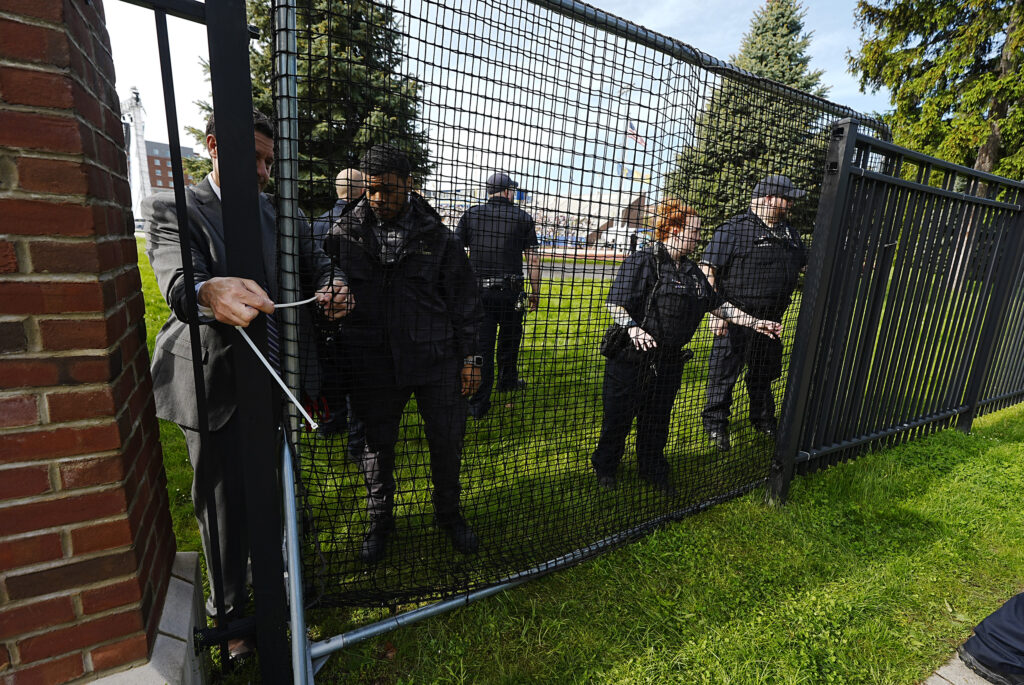
As a peace officer, training cannot exceed 180 hours of your time, a fraction of the 700 hours designated for full police officers, who have broad authority to work for a variety of departments, conduct felony arrests and write warrants.
Training certifications can be revoked when an officer commits certain kinds of misconduct — basically having their license revoked, according to the U.S. Department of Justice. That’s different from being fired, which allows someone to apply somewhere else in law enforcement. But decertification isn’t always a clear, final line.
What happens when a peace officer gets fired?
According to DCJS, a peace officer’s decertification doesn’t always mean the end of their career, unlike police officers — who “have their training permanently invalidated and no longer have the option of retaking the state-mandated basic training.”
Peace officers are permitted to be rehired solely as peace officers once they retake basic training within a year of appointment.
Peace officers can be decertified for a range of serious problems: criminal activity, dishonesty, excessive force, sex abuse or gross negligence. They can also lose certification if their actions are connected to any of those violations.
While the opportunity to re-enter the police force after significant misconduct exists under certain circumstances, law enforcement experts advise agencies against rehiring previously decertified officers.
University watchdogs: Accreditation?
Oversight does exist for campus public-safety agencies, but it comes via voluntary accreditation programs rather than state regulation. Many colleges decide to have their police or public-safety departments accredited by CALEA, an outside body that reviews policies, training and oversight practices. This kind of accreditation is different from a university’s academic accreditation — which evaluates things like curriculum, finances and student services.
Accreditation reviewers do pay attention when multiple officers at the same agency have been decertified.
“If we saw several officers decertified, we’d look into how the agency handled it — were the officers disciplined properly, and how did the situation unfold?” said Tom Kulhawik, CALEA’s northeast program manager. He said decertifications tend to raise concerns during annual reviews even though the accreditation process doesn’t control them.
Second chances and student concerns
According to the latest Bureau of Justice Statistics data, almost 1,300 campus law-enforcement agencies were serving at U.S. four-year colleges and universities with at least 1,000 full-time students in the 2021-2022 academic year, employing 17,600 full-time sworn officers nationwide.
Decertification failing to strike these peace officers with the same impact as police is leaving college students torn, especially as cases such as Tennity’s aren’t specific to just the University of Rochester.
The lack of supervision continues.
Sixty-two percent of private colleges nationwide do not swear in their officers. RIT is among them, according to a university spokesperson.
An officer with the name “Tyler Wilson” appears to work for RIT’s public safety office. Tyler Wilson was also the name of a public safety officer decertified by the University of Rochester in December 2021. We could not confirm these were the same people.
The University of Rochester, RIT and Wilson were all contacted about his decertification, but declined to comment on the situation. DCJS has not been clear about why officers have been decertified across the state, leaving students and community members in the dark about the level of possible mistake or misconduct committed in the past by now-rehired officers.
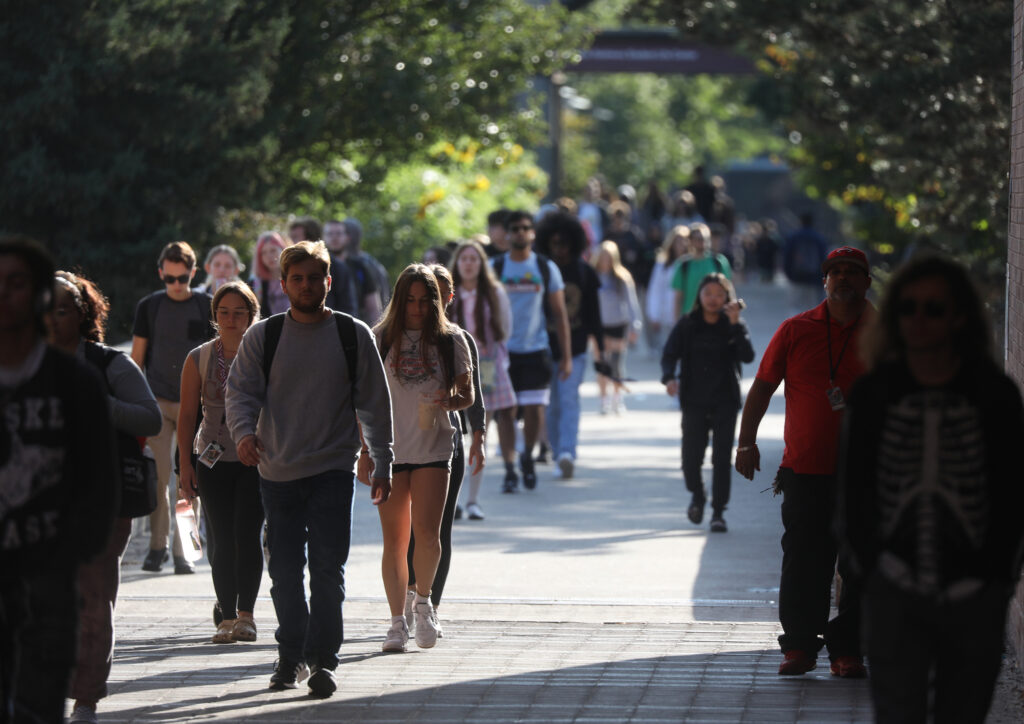
Griffin Dobbs, a first-year mechanical engineering student in Rochester, said it could be worrying that people who lost their certification could be security officers at the Rochester Institute of Technology. However, he feels the campus overall is safe.
His worry about security officers would depend in each case on what they did to be decertified. “I think (most) should have a second chance,” Dobbs said. “… I’m torn.”
Ryiah Rand, a first-year student at RIT, said she appreciates the measures and tactics RIT has implemented to keep students safe on campus. However, after talking about a possible Tyler Wilson hiring connection and RIT Public Safety’s hiring practices, she, along with other students, expressed reduced confidence in the school’s campus safety.
“Hearing that now, it’s a little bit disconcerting,” said Rand.
“I didn’t really know that,” said Delaney Hitchcock, a first-year student at RIT, referring to RIT’s lack of third-party certification for its campus security, “but it doesn’t sound too good.”
Other students were torn about how to feel about the situation, because the university hasn’t shared. “Without knowing the specifics of the situation, it’s hard to tell for sure,” said fourth-year student Alex Staph when asked if knowing about our story changes his opinions on campus safety.
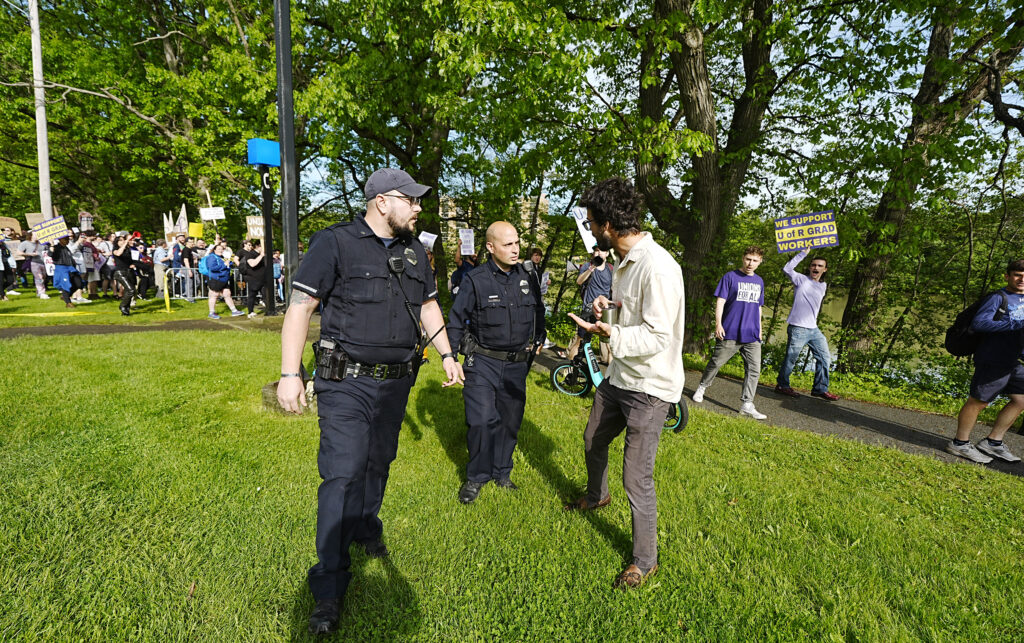
Should decertification be the end?
The unique opportunity for peace officers to get recertified can be viewed as a pathway to rehabilitation. While campus security officers at RIT don’t require the peace officer certification process in the first place, students at RIT still believe other decertified officers shouldn’t be barred from working in law enforcement permanently.
“I would say if you put in the effort to be better, then I think you would deserve a second chance,” said Rand. “We’re human, we all screw up. But at the same time, you have to know where to draw the line, because [someone’s prior on-the-job] mistake could have cost people’s safety.”
Other students have confidence that the school’s procedures for hiring new safety officers are precautionary.
“I trust that the university is looking into all the things they need to look into,” said Keleena Bressett, a first-year student at RIT, “and I need to trust that they believe that they’re going to do everything to keep us safe.”
As of the writing of this article, Tennity is still employed as a peace officer with the state Office of Mental Health, defying a process meant to end his career. His story, like others, proves decertification as it stands now is not the end.
“I know my character, I know who I am,” Tennity said.
— All officers mentioned in this story were contacted for comment; a full list of decertified officers can be found on the Division of Criminal Justice Services website.
This story contains reporting from Syracuse University journalists Kendall Luther and Haley Moreland.
About the project
This story is part of a series called Shielded From Consequence, looking at the decertification of law enforcement officers in New York. The series is produced in partnership with the USA Today Network, Central Current and Syracuse University with reporting students from the Newhouse School.

is a digital producer for The NewsHouse.

is a contributor for The NewsHouse.

is a contributor for The NewsHouse.

is a digital producer for The NewsHouse.