
Inside the sound
Inside the sound
A first-person look at how Syracuse’s pep band creates and sustains energy, even as the game slips away in the NCAA tournament.
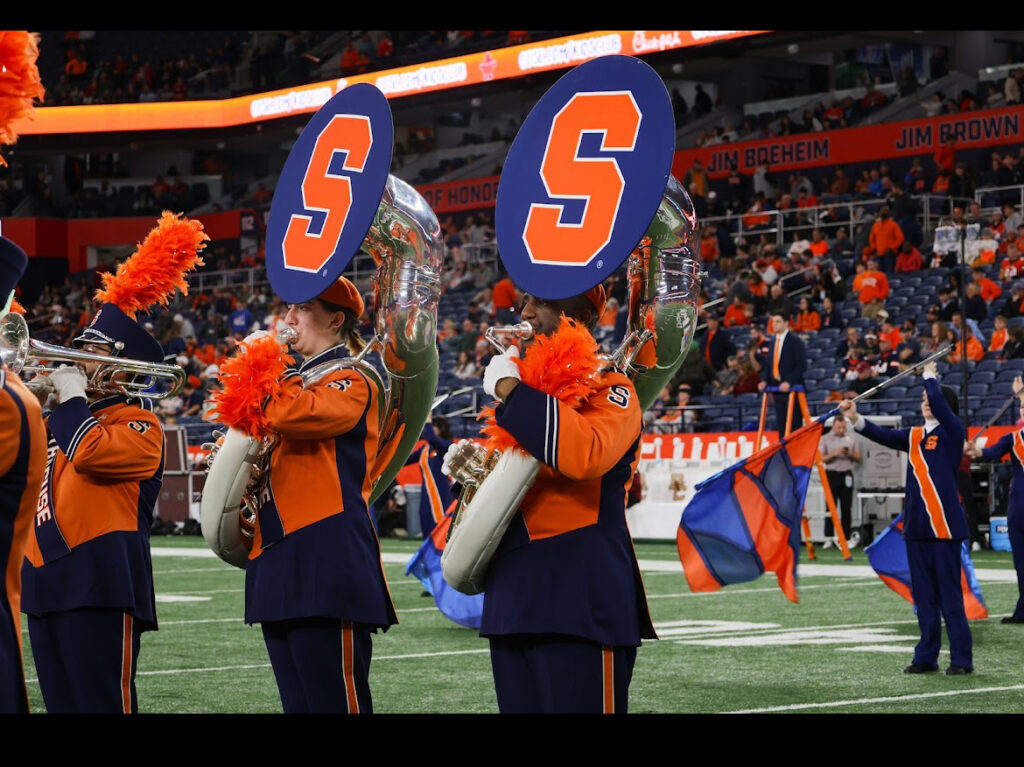
Not every role at the NCAA tournament is on the court. For the Syracuse Marching Band, it starts in the stands, with energy, tradition and Otto leading the way.
From my seat in the pep band, the rhythm never really stops. A missed shot, a fast break, a timeout — it all blends into one continuous soundtrack. You’re not watching the game the way fans do. You’re trying to keep the energy alive, even when everything else starts slipping away.
That was never more apparent than during Syracuse women’s basketball’s NCAA tournament matchup against UConn. We traveled with the team to Storrs, Conn., to energize the Orange fans during the women’s run in March Madness.
From the opening minutes, you could feel the momentum building, and not in Syracuse’s favor.
UConn came out dominant, putting together long scoring runs and overwhelming Syracuse early. At one point, the Huskies went on a massive 31-0 run and carried a historic lead into halftime, eventually winning 98-45 in what became SU’s worst NCAA tournament loss.
From the stands, we didn’t need the scoreboard to tell us that. We could feel it.
Still, the job didn’t change.

A pep band isn’t just background noise. It’s part of the game. The purpose is simple: create energy, sustain it and manufacture it when it disappears. In a game like this, that last part matters most.
Between possessions, we kept playing. Short bursts. Fight song fragments. Anything to keep some life in the building.
It reminded me that what people see on game day is only a fraction of what goes into it.
Traveling for events like this takes coordination, preparation and constant adjustment, something bands across the country experience for a tournament trip or something as large-scale as performing in New York City.
When I was a part of the University of South Carolina’s marching band preparing for the Macy’s Thanksgiving Day Parade, it required months of planning, transportation, rehearsals and equipment logistics just to make the performance possible.
Even on a smaller scale, those same challenges show up here at Syracuse.
You’re thinking about music, but also timing, cues, communication and stamina. You’re reacting to the game while staying locked into your own performance. There’s no pause button.
And then there’s the emotional side.
When Syracuse started to fall further behind, the morale shifted. The energy dipped. That’s when the band’s role becomes clearest, not to ignore what’s happening, but to respond to it.
We kept playing anyway, because sometimes the job isn’t about celebrating, it’s about supporting.
There’s a strange balance to being both part of the moment and observing it. As a journalist, I’m trained to watch, analyze and contextualize. As a band member, I’m reacting in real time, contributing to the environment rather than just documenting it.
That dual perspective changes how you see everything.
You notice how quickly momentum swings, how even a short burst of music can shift attention.
And when the final buzzer sounds, the experience doesn’t end with the game.
The band packs up. The crowd filters out. The arena empties.
But for a few hours, you were part of something larger than yourself, win or lose.
That’s what stays with you.
Not just the score, or the result, but the role you played in the moment, helping create the sound, the energy and the experience that defines college sports, even on its toughest days.

is a contributor for The NewsHouse.